

What is carrier screening and should I have it before pregnancy?
Carrier screening checks whether you carry gene changes that could cause serious inherited conditions in your children. It's most useful before or early in pregnancy, but the NHS doesn't routinely offer it to everyone.
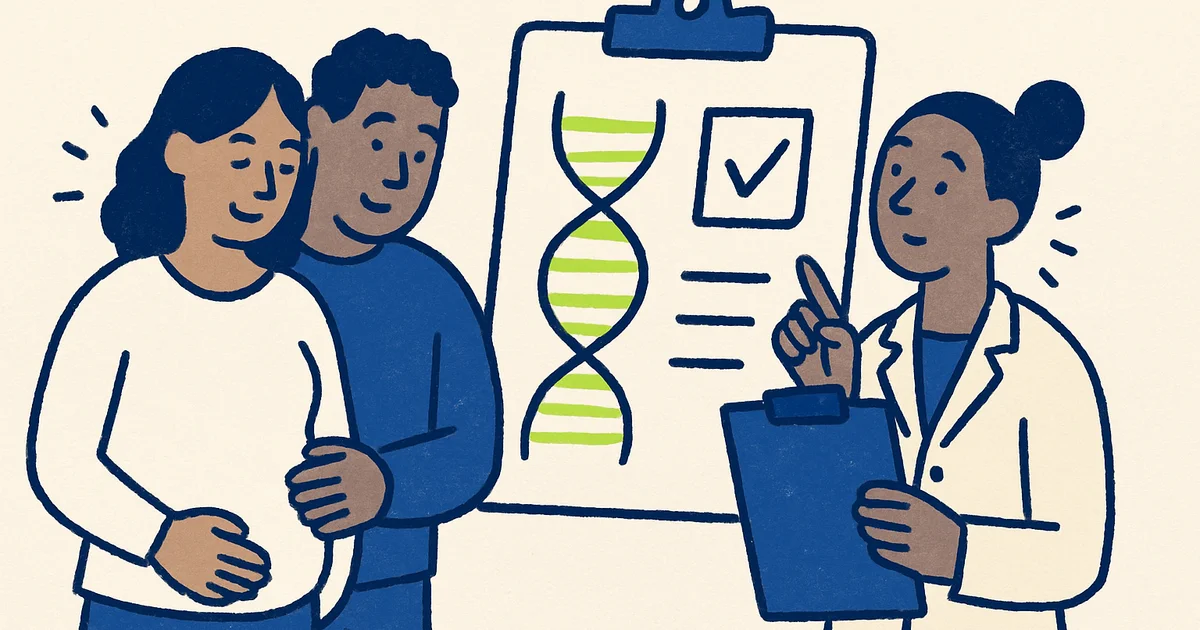
Carrier screening is a type of genetic test you can have before or during early pregnancy to find out whether you carry gene changes that could cause serious inherited conditions in your children. Unlike screening that looks for problems in a pregnancy (like the combined test at 12 weeks), carrier screening looks at your own genes to work out future risk.
Most people who are carriers are healthy and have no symptoms. For most of the conditions on a carrier screen, which are recessive, you only pass on a condition if both parents carry a change in the same gene. When that happens, each pregnancy has a 1 in 4 (25%) chance of the child inheriting two copies of the gene change and being affected.
What conditions does carrier screening look for?
Carrier screening usually focuses on recessive conditions - disorders that only cause symptoms when a child inherits a faulty gene copy from both parents. Some panels also include certain X-linked conditions, which are passed on differently. Conditions commonly covered include:
- Cystic fibrosis - a lung and digestive condition caused by changes in the CFTR gene. It is one of the most common recessive conditions in people of Northern European heritage, with a frequency of around 1 in 2,500 births and roughly 1 in 25 people carrying a single CFTR change
- Sickle cell disease and thalassaemias - blood conditions affecting haemoglobin, more common in families with African, Caribbean, Mediterranean, Middle Eastern or South Asian heritage
- Spinal muscular atrophy - a progressive muscle-weakening condition affecting motor neurons
- Fragile X syndrome - the most common inherited cause of learning disability. Unlike the conditions above, Fragile X is X-linked rather than autosomal recessive, so it is inherited differently, but it is often included on expanded panels
- Tay-Sachs disease - a progressive neurological condition, more common in Ashkenazi Jewish families
Expanded carrier screening panels test for many recessive (and some X-linked) conditions at once. Depending on the laboratory, panels can range from a handful of conditions to several hundred, and some of the largest commercial panels screen more than 1,000 genes, covering conditions that range from severe and life-limiting to milder treatable disorders.
Who should consider carrier screening?
Until recently, carrier screening in the UK was mainly offered to people with a family history of a specific condition or from ethnic groups known to have higher carrier rates for certain disorders (for example, thalassaemia screening for people with Mediterranean or South Asian heritage).
Professional thinking has shifted towards offering screening more widely. In 2017, the American College of Obstetricians and Gynecologists set out that ethnic-specific, pan-ethnic and expanded carrier screening are all acceptable approaches, and that a consistent approach should ideally be offered to each patient before pregnancy. In 2021, the American College of Medical Genetics and Genomics went further, recommending that a defined panel of recessive and X-linked conditions be offered to all people who are pregnant or planning a pregnancy, regardless of ethnicity or family history. The reasoning is that everyone carries several recessive gene changes, and many serious conditions occur in families with no known history. These are US professional recommendations; UK practice differs.
The NHS does not routinely offer pre-conception carrier screening to everyone. You can access carrier screening through:
- Private genetic testing services that offer panel tests covering hundreds of genes
- NHS genetics clinics if you have a family history of a specific inherited condition (your GP can refer you)
- NHS antenatal screening for sickle cell disease and thalassaemia, offered to all pregnant women in England - but this happens during pregnancy, not before
What happens if both partners are carriers?
If carrier screening finds that both you and your partner carry a change in the same recessive gene, you have several options:
- Conceive naturally with the knowledge that each pregnancy has a 25% chance of the child being affected, a 50% chance of being a carrier like you, and a 25% chance of inheriting neither changed gene
- Prenatal testing during pregnancy (chorionic villus sampling at 11–14 weeks or amniocentesis at 15+ weeks) to find out whether the baby has inherited both copies
- Pre-implantation genetic testing (PGT) with IVF, where embryos are tested before transfer so only unaffected embryos are used - available privately or through NHS funding in some areas
- Use of donor sperm or eggs from someone who is not a carrier
- Adoption or remaining child-free
A genetic counsellor can talk through these options with you in detail, including the likely severity of the condition, available treatments, and what life might look like for an affected child.
When is the best time to have carrier screening?
The ideal time is before you start trying to conceive. This gives you time to:
- Understand your results without the pressure of an ongoing pregnancy
- Have your partner tested if you’re found to be a carrier
- Explore all reproductive options, including PGT with IVF if you’re both carriers for the same condition
- Make informed decisions about family planning
You can still have carrier screening during early pregnancy, but it leaves less time to make decisions if both partners are carriers. Some people choose prenatal diagnosis, which carries a small additional miscarriage risk - for amniocentesis this is estimated at around 0.5% (about 1 in 200) for a single pregnancy, and UK guidance puts the added risk for both amniocentesis and chorionic villus sampling at below 0.5% when performed by an experienced operator. Others decide to continue the pregnancy regardless of the result, but value knowing in advance so they can prepare.
How carrier screening differs from other pregnancy tests
Carrier screening is different from:
- Non-invasive prenatal testing (NIPT) - looks for chromosomal conditions like Down’s syndrome in the current pregnancy by analysing fetal DNA in the mother’s blood
- Newborn blood spot screening - the heel-prick test checks whether a newborn has certain treatable conditions, not whether parents are carriers
- Diagnostic tests like amniocentesis - these test the baby directly during pregnancy, not the parents’ carrier status
Carrier screening tests your own genes, not a developing baby’s. Your carrier status doesn’t change - the results are relevant for all future pregnancies.
What you can do at Jeen
Jeen’s Carrier Screening analyses 1,008 genes associated with inherited conditions, mostly recessive disorders along with some X-linked conditions such as Fragile X. It’s designed for couples planning a pregnancy and includes:
- 30-minute genetic counselling included with every test to help you understand your results and options
- NHS Genomic Medicine Service-aligned interpretation, so variants are classified using the same standards used in NHS genetics
- An at-home buccal swab kit - no need to visit a clinic, or we can arrange a blood draw at a partner collection point (+£40) or a home-nurse visit (+£65)
- Results within 17-21 working days of your sample reaching the laboratory
The NHS offers sickle cell and thalassaemia carrier screening to all pregnant women, but does not routinely provide pre-conception screening for the hundreds of other recessive conditions that expanded panels cover. Jeen’s panel includes cystic fibrosis, spinal muscular atrophy, Fragile X syndrome, and over 1,000 genes in total.
If you also want to understand your own risk of hereditary cancers, the Combined Cancer + Carrier Screening bundles our 50-gene cancer panel with the full 1,008-gene carrier panel - one counselling session, one report, better value than ordering separately. This is useful if you’re both planning a family and have a personal or family history of cancer.
Sources & further reading
- NHS: Cystic fibrosis Accessed 16 June 2026.
- Cystic Fibrosis - GeneReviews (NCBI Bookshelf, NBK1250) Accessed 16 June 2026.
- ACOG Committee Opinion No. 691: Carrier Screening for Genetic Conditions (2017) DOI:
10.1097/AOG.0000000000001952. Accessed 16 June 2026. - Gregg AR et al. Screening for autosomal recessive and X-linked conditions during pregnancy and preconception: a practice resource of the ACMG (2021) DOI:
10.1038/s41436-021-01203-z. Accessed 16 June 2026. - NHS GeNotes: Amniocentesis (NHS Genomics Education Programme) Accessed 16 June 2026.
- RCOG Green-top Guideline No. 8: Amniocentesis and Chorionic Villus Sampling Accessed 16 June 2026.
- NHS: Screening for sickle cell and thalassaemia in pregnancy Accessed 16 June 2026.
- MedlinePlus: Genetic Testing Accessed 16 June 2026.