




 1 / 6
1 / 6 Polygenic Risk Score Test
Understand your inherited risk across more than 20 conditions - common cancers, heart disease and stroke, raised cholesterol, type 2 diabetes, Alzheimer's and more - from a single home saliva sample, with ancestry-specific analysis by Allelica. A polygenic risk score (PRS) estimates inherited risk only: it's not a diagnosis, doesn't replace NHS screening, and its predictive accuracy varies from condition to condition.
Ancestry-specific polygenic risk scores across 20+ conditions - common cancers, heart disease & stroke, cholesterol, type 2 diabetes, Alzheimer's and more
Estimates inherited risk only - not a diagnosis, not a prediction, and not a replacement for NHS screening
Predictive performance varies by condition and by ancestry - your counselling session explains how much weight to give each score
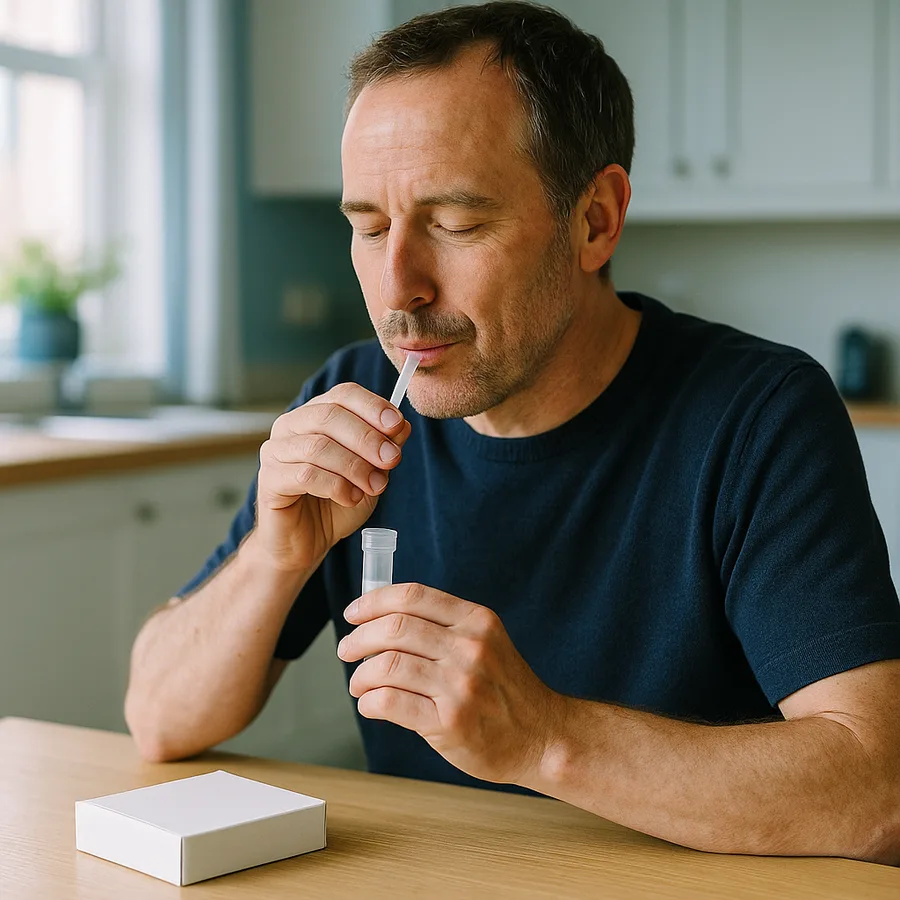
Simple at-home saliva kit - no clinic visit, no blood, posted to your door
Powered by Allelica's ancestry-specific models, with a genetic-counselling consultation included
What a polygenic risk score tells you
Most common diseases - heart disease, type 2 diabetes, the common cancers - aren't caused by a single faulty gene. They're shaped by the combined effect of large numbers of common DNA variants, each nudging your risk up or down by a tiny amount. A polygenic risk score (PRS) adds all of those small effects together into one number: an estimate of how your inherited risk for a condition compares with the rest of the population.
That makes a PRS fundamentally different from the genetic tests you may already know:
- Carrier screening looks for rare recessive variants that matter for family planning.
- Hereditary cancer panels (e.g. BRCA1/2) look for rare, high-impact mutations.
- A polygenic risk score captures the common genetic background that everyone carries - the part conventional gene tests miss.
It estimates inherited risk only: a PRS is not a diagnosis, not a prediction that you will or won't develop a condition, and not a replacement for the NHS screening you're entitled to.
Want the full picture? Read our guide to how polygenic risk scores work - from genome-wide studies to your personalised result.
The conditions we score
Your report gives an ancestry-specific polygenic risk score across more than 20 conditions, grouped into:
- Cancers - breast (women), ovarian (women), prostate (men), pancreatic, colorectal (bowel) and melanoma
- Heart & circulation - coronary artery disease, stroke, atrial fibrillation and high blood pressure
- Cholesterol & lipids - high cholesterol, high triglycerides, low HDL ("good") cholesterol and raised lipoprotein(a)
- Metabolic - type 2 diabetes and body-mass index
- Brain - Alzheimer's disease (see the note below)
- Immune, digestive, bone & hormonal - inflammatory bowel disease, coeliac disease, osteoporosis and early menopause (women)
The exact set scored depends on your sex and anatomy - breast and ovarian scores are reported for women, prostate for men.
Predictive performance is not the same for every condition. Polygenic scores are more strongly established and validated for some conditions (such as coronary artery disease, breast cancer, type 2 diabetes and lipoprotein(a)) than for others, and accuracy also varies by genetic ancestry. Treat each score as one input among many - not a verdict - and use the free genetic-counselling consultation to understand how much weight to give each result.
A note on the Alzheimer's score. Alzheimer's risk is dominated by a single common gene (APOE), so this result behaves more like a single-gene finding than a true polygenic score, and its accuracy varies more by ancestry. There is currently no proven way to prevent Alzheimer's disease, and some people find this result distressing. We strongly recommend using the free genetic-counselling consultation included with your order - before and after testing - to decide whether you want this score and to understand what it means.
Why ancestry matters - and why we use Allelica
Here's the catch most direct-to-consumer DNA tests don't mention: the large majority of published polygenic scores were built almost entirely from European-ancestry data, and they lose accuracy when applied to people of African, South Asian, East Asian or mixed heritage.
Allelica is built specifically to address this. Its models are ancestry-specific, designed to give a better-calibrated score across diverse backgrounds. These methods narrow that accuracy gap rather than remove it entirely - but they make your result more reliable than a one-size-fits-all score, whatever your heritage. That calibration is the single biggest reason we chose Allelica as our lab partner.
What's included
- Ancestry-specific polygenic risk scores for every condition on your panel
- An at-home saliva-collection kit, posted to your door - no clinic visit, no blood, no fasting
- Laboratory genotyping and analysis by Allelica
- A personalised, plain-English report showing where you sit relative to the population, for each condition
- A free consultation with a genetic counsellor to talk through what your results mean and what to do next
What a polygenic risk score can - and can't - do
We think it's important to be straight about this.
A PRS can show that your inherited risk for a condition is higher (or lower) than average - which, alongside your other risk factors, can help you and your doctor think about prevention and screening.
A PRS cannot diagnose disease or tell you whether you will develop a condition, and it is not equally reliable for every condition on the panel. Your actual risk also depends on age, sex, family history, lifestyle and clinical measurements like blood pressure and cholesterol. A high score is not a diagnosis, and a low score is not a guarantee. We recommend discussing your result with a GP or a genetic counsellor before making any medical decisions - and this test is not a substitute for the NHS screening you're already entitled to.
Who it's for
Adults (18+) who want to understand their inherited risk for common diseases and use it to think about prevention earlier - especially anyone with a family history of heart disease, stroke, diabetes, raised cholesterol, the common cancers or dementia who wants a clearer picture than family history alone can give.
The logistics, simply.
Everything you need to know about shipping, blood draw, and suitability.
Kit delivery & logistics
Kit delivery & logistics
1. Get your kit from us. Free delivery of your test kit, dispatched by next-day delivery after your included 30-minute genetic counsellor consultation (video or phone) and once your test choice is confirmed. Changed your mind? Return the kit unused within 30 days at no charge.
2. Easy returns. After sample collection, send your sample in the pre-paid bag to the nearest depot (details in your email). Turnaround is counted in working days from when your sample reaches the laboratory.
Sample / draw options
Sample / draw options
Saliva kit : Saliva collection kit, sent to your home.
Test suitability
Test suitability
Genetic testing with Jeen Health is suitable for adults who have completed a pre-test consultation with one of our genetic counsellors - in clinic, over video, or by phone.
Genetic testing with Jeen Health is only available to individuals aged 18 and over.
Three steps. That's it.
Simple, clinician-supported steps to take your test with Jeen.
Talk to a clinician
Book your included 30-minute consultation with our genetic counsellor (video or phone). Confirm the test that's right for you.
Consent + collect
Complete your consent form online, receive your kit, and collect your sample at home or via a clinic of your choice.
Results + follow-up
Your results are reviewed by your genetic counsellor. We share them with you securely, and book a follow-up consultation with onward referrals if your result is high-risk.
Compare every option we offer.
From the basic panel to our most advanced option.


Frequently asked questions.
What is a polygenic risk score?
How is this different from a BRCA or carrier test?
Which conditions does the test cover?
Are all the scores equally reliable?
Can a polygenic risk score diagnose disease or predict that I'll get it?
Why does ancestry matter for accuracy?
How is the sample collected and how long do results take?
Do I need a GP referral, and is this available on the NHS?
Methodology
Genotyping and polygenic-risk analysis are performed by Allelica. A polygenic risk score is computed by combining the effects of large numbers of common variants (typically imputed genome-wide) using validated, ancestry-specific models, then calibrated against reference populations to express each result as a percentile / relative-risk position. Scores are reported across more than 20 conditions spanning common cancers, cardiovascular and lipid traits, type 2 diabetes, Alzheimer's disease, and selected immune, digestive, bone and hormonal conditions; the exact panel depends on the individual's sex.
What a PRS is - and isn't
A polygenic risk score estimates relative inherited risk at a population level. It is not a diagnostic test, does not detect rare single-gene (monogenic) conditions, and should be interpreted alongside clinical risk factors. Predictive performance and validation vary by condition and by genetic ancestry - some scores are well established, others more exploratory - so each result is best read as one input among many. A clinician or genetic counsellor can help you put your result in context.
References
- Khera AV, Chaffin M, Aragam KG, et al. Genome-wide polygenic scores for common diseases identify individuals with risk equivalent to monogenic mutations. Nature Genetics (2018).
- Lewis CM, Vassos E. Polygenic risk scores: from research tools to clinical instruments. Genome Medicine (2020).
- Martin AR, Kanai M, Kamatani Y, et al. Clinical use of current polygenic risk scores may exacerbate health disparities. Nature Genetics (2019).
- National Human Genome Research Institute - Polygenic Risk Scores: https://www.genome.gov/Health/Genomics-and-Medicine/Polygenic-risk-scores
Talk to a specialist.
Our team is here to help. Whether you're curious about testing, your results, or what's right for you - we're a message away.
Book a consultationThis test is currently sold out
New kits ship in mid-November. You can still book in advance today - we'll post your kit as soon as the new stock arrives. Payment is taken at checkout as normal.