

Should I have genetic testing for hereditary breast and ovarian cancer if I have Ashkenazi Jewish heritage?
People of Ashkenazi Jewish heritage have a higher chance of carrying certain gene changes that increase the risk of breast and ovarian cancer. Here's what you need to know about genetic testing if this applies to you.
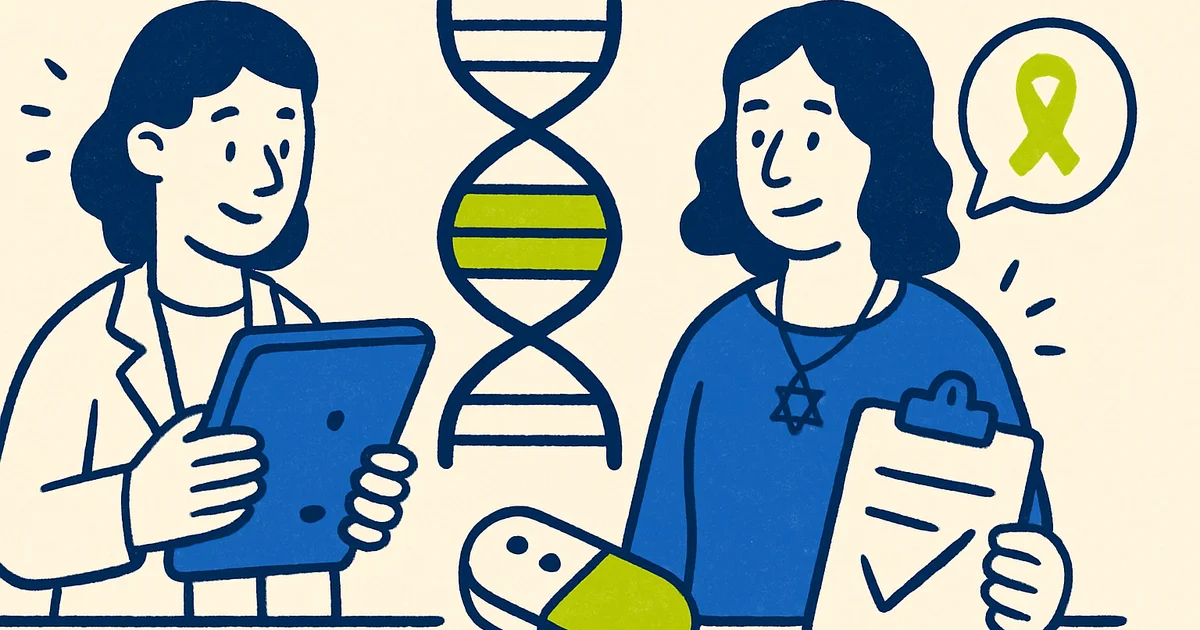
If you have Ashkenazi Jewish heritage, you may have heard that your chance of carrying certain gene changes linked to cancer is higher than in the general population. This is true - and it means genetic testing might be particularly relevant for you, even if you don’t have a strong family history of cancer.
Why Ashkenazi Jewish heritage matters for cancer risk
People with Ashkenazi Jewish ancestry (families originating from Central or Eastern Europe) have a higher chance of carrying particular changes in the BRCA1 and BRCA2 genes. These genes normally help protect against certain cancers, but when they contain a pathogenic variant (a harmful change), the risk of developing breast, ovarian, and some other cancers increases substantially.
Three specific BRCA variants - known as founder mutations - are much more common in the Ashkenazi Jewish population than in the general population. This is due to what geneticists call a ‘founder effect’: the variants became more frequent because they were present in a small ancestral population.
Most cancers develop due to a combination of factors including age, lifestyle, and chance. However, up to 10% of all cancers are related to an inherited genetic mutation that runs in families. Among people of Ashkenazi Jewish heritage, the proportion linked to these inherited BRCA variants is higher than in other populations.
What does carrying a BRCA variant mean for cancer risk?
Carrying a pathogenic variant in BRCA1 or BRCA2 does not mean you will definitely develop cancer - it means your risk is higher than average. The term for this increased chance is ‘penetrance’.
For women carrying a BRCA1 or BRCA2 variant:
- Breast cancer risk is substantially increased compared to the general population
- Ovarian cancer risk is also notably higher
- Cancers may develop at younger ages than in people without these variants
For men carrying a BRCA variant:
- Breast cancer risk is increased (breast cancer is rare in men generally, but much less rare in BRCA carriers)
- Prostate cancer risk is also higher
BRCA1 and BRCA2 are not the only genes that matter. Multigene panel testing can identify pathogenic variants in other genes with high or moderate penetrance for breast cancer, such as PALB2, CHEK2, and ATM. These genes are included in comprehensive hereditary cancer screening.
Who should consider genetic testing?
Genetic testing is most useful when:
- You have Ashkenazi Jewish heritage and a personal history of breast or ovarian cancer - knowing whether you carry a BRCA variant can influence your treatment and follow-up, and helps your family members understand their own risk.
- You have Ashkenazi Jewish heritage and a family history of breast, ovarian, prostate, or pancreatic cancer - even one close relative diagnosed at a younger age may be significant.
- You’re thinking about starting a family - if you carry a BRCA variant, each of your children has a 50% chance of inheriting it; some people want to know this before having children.
- You want to understand your own cancer risk - even without a family history, some people of Ashkenazi Jewish heritage choose testing because their baseline chance of carrying a variant is higher.
The NHS offers genetic testing and counselling if you meet certain criteria, which generally include a significant personal or family history of cancer. If you don’t meet NHS referral criteria but still want testing - for example, because you have Ashkenazi Jewish heritage but no diagnosed cancers in the family yet - private testing is an option.
What happens during genetic testing?
Genetic testing involves:
- Pre-test counselling - a specialist genetic counsellor or clinician explains what the test looks for, what results might mean, and how they could affect you and your family. This is an essential part of the process and is included in every Jeen test.
- Providing a sample - usually a blood sample or a cheek swab (buccal swab). At-home cheek-swab kits are available for many tests.
- Laboratory analysis - your DNA is examined for pathogenic variants in the genes on the panel. This typically takes a few weeks.
- Results and follow-up - you receive your results with an explanation of what they mean, and guidance on what to do next.
There are three possible outcomes:
- A pathogenic or likely pathogenic variant is found - you have an increased cancer risk and can discuss risk-reducing options (such as enhanced screening, preventive medication, or risk-reducing surgery) with your doctor.
- No pathogenic variant is found - your cancer risk is similar to the general population, though this doesn’t mean zero risk - screening at population levels is still recommended.
- A variant of uncertain significance (VUS) is found - the test identifies a gene change, but scientists don’t yet know whether it affects cancer risk. This result doesn’t usually change your care, and you’re managed based on your personal and family history.
What can you do if you test positive?
If testing identifies a pathogenic variant, several options can help reduce your cancer risk or detect cancer early:
- Enhanced screening - more frequent mammograms or MRI scans, starting at a younger age, and regular checks for ovarian cancer.
- Risk-reducing medication - certain drugs can lower breast cancer risk in some people.
- Risk-reducing surgery - some women choose to have their breasts and/or ovaries removed before cancer develops; this is a major decision made with specialist support.
- Informing family members - close relatives (siblings, children, parents) can be offered testing for the specific variant found in you, which is quicker and cheaper than a full panel.
Knowing you carry a pathogenic variant can also guide cancer treatment if you do develop cancer. For example, BRCA-related cancers may respond to particular therapies that wouldn’t be used otherwise.
What you can do at Jeen
Jeen offers several genetic testing options for hereditary cancer risk, all with specialist genetic counselling included:
-
BRCA Testing - a focused 10-gene panel covering BRCA1, BRCA2, and the most actionable BRCA-pathway genes for hereditary breast, ovarian, prostate, and related cancers. Every test includes 45-minute specialist genetic counselling, NHS Genomic Medicine Service-aligned variant interpretation, an at-home buccal swab (in-clinic blood draw available for an additional £40), and results within 17-21 working days of the sample reaching the laboratory.
-
Breast Cancer Risk Screening - a 13-gene panel focused on hereditary breast cancer predisposition, with genetic counselling included and the same sample options and turnaround.
-
Ovarian Cancer Risk Screening - a 12-gene panel focused on hereditary ovarian cancer predisposition, again with counselling included, an at-home swab or in-clinic draw (+£40), and results in 17-21 working days from sample receipt.
-
Cancer Risk Screening - a comprehensive 50-gene hereditary cancer-risk panel that covers a broader range of cancer predisposition genes. Includes 45-minute specialist genetic counselling, NHS-aligned interpretation, at-home swab or in-clinic blood draw (+£40), and results within 17-21 working days of sample receipt.
-
Combined Cancer + Carrier Screening - bundles the 50-gene hereditary-cancer panel with a 1,008-gene carrier-screening panel in one test. This is the best-value option if you want both pre-conception insights (to understand risks of passing on recessive conditions) and your own cancer predisposition assessed together, with one counselling session and one report.
The NHS offers genetic testing when you meet specific clinical criteria, typically involving a significant personal or family cancer history. Jeen’s panels provide broader access - useful if you have Ashkenazi Jewish heritage and want to understand your risk proactively, even without a strong family history yet. All tests are analysed in accredited laboratories with interpretation aligned to NHS Genomic Medicine Service standards.
Sources & further reading
- Patel MM, Adrada BE. Hereditary Breast Cancer: BRCA Mutations and Beyond. Radiol Clin North Am. 2024 DOI:
10.1016/j.rcl.2023.12.014. Accessed 18 September 2026. - Pensabene M, Calabrese A, von Arx C, et al. Cancer genetic counselling for hereditary breast cancer in the era of precision oncology. Cancer Treat Rev. 2024 DOI:
10.1016/j.ctrv.2024.102702. Accessed 18 September 2026. - Van Cott C. Cancer Genetics. Surg Clin North Am. 2020 DOI:
10.1016/j.suc.2020.02.012. Accessed 18 September 2026. - NHS. BRCA gene - what it means to have an altered BRCA gene Accessed 18 September 2026.