

When should my GP consider pharmacogenomic testing if I'm not responding to blood pressure medication?
If your blood pressure medication isn't working as expected or causes side effects, pharmacogenomic testing may help in some cases, but the evidence for most blood pressure drugs is limited. Here's what it can and can't tell you, and when to discuss it with your GP.
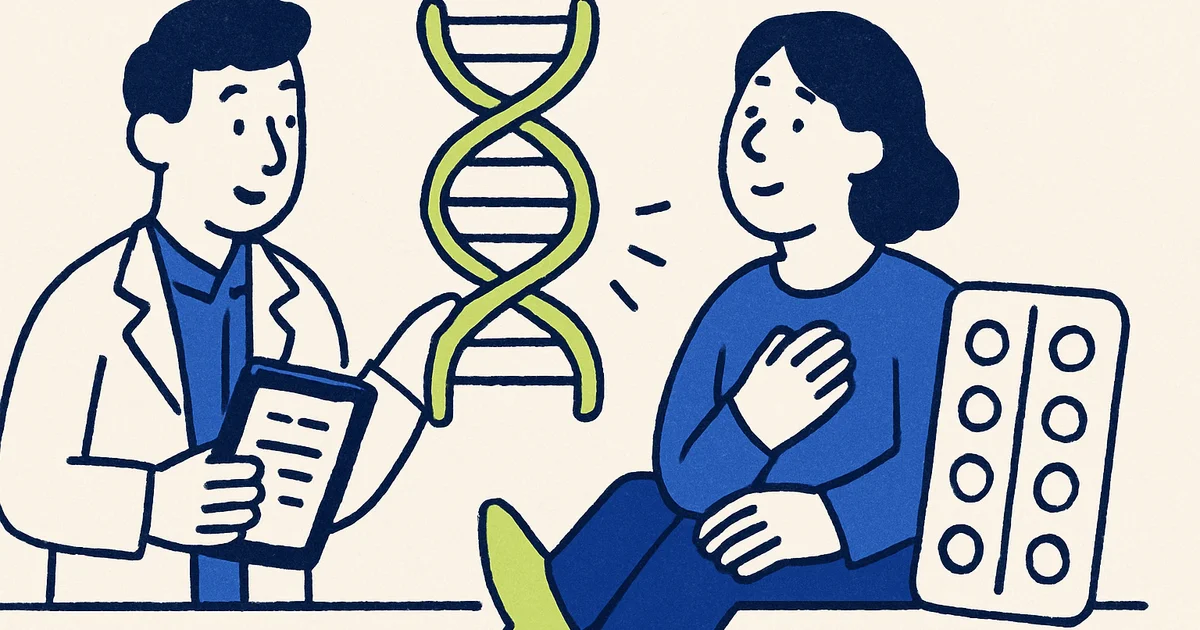
High blood pressure (hypertension) affects millions of people in the UK and usually requires medication to manage. But not everyone responds to the same drugs in the same way - what works well for one person might cause side effects or simply not control blood pressure effectively in another. Pharmacogenomic testing looks at how your genes affect the way your body processes medication. For a small number of medicines it can help guide prescribing, but for most blood pressure medicines the evidence is limited and it is not yet routine care.
What is pharmacogenomic testing?
Pharmacogenomic testing (often shortened to PGx testing) analyses specific genes that influence how your body metabolises and responds to medications. These genes control the enzymes that break down drugs in your liver, the proteins that transport drugs around your body, and the receptors that drugs bind to.
The evidence is strongest for a few specific gene-drug pairs: for example CYP2C19 and clopidogrel, SLCO1B1 and simvastatin, and CYP2C9 and VKORC1 with warfarin, where the Clinical Pharmacogenetics Implementation Consortium (CPIC) gives prescribing guidance. For most blood pressure medicines, including ACE inhibitors, angiotensin receptor blockers, thiazide diuretics and calcium channel blockers, the evidence is limited. The test uses a simple saliva or cheek swab sample and screens multiple genes at once, providing information about many different medications you might take now or in the future.
Pharmacogenomic testing does not diagnose disease or predict whether you will develop high blood pressure. Instead, it helps identify which medications are more likely to work well for you, which might need a different dose, and which could cause unwanted effects based on your genetic makeup.
When might pharmacogenomic testing be useful for blood pressure medication?
Your GP might consider pharmacogenomic testing if:
-
You’ve tried two or more blood pressure medications without achieving good control. Before considering a genetic test, your GP will usually check more common reasons for poor control, such as whether the medicines are being taken as prescribed, whether blood pressure readings are accurate (for example with home or 24-hour monitoring), salt intake, other medicines, and other medical causes of high blood pressure. A genetic explanation is less common.
-
You’ve experienced significant side effects from multiple blood pressure drugs. Genetic variation may make certain side effects more likely for some medicines, although for most blood pressure drugs this is not well established.
-
You’re taking several medications for other conditions alongside blood pressure treatment. Gene variants can affect how different drugs interact in your system, and pharmacogenomic information may help your GP choose combinations that work better together.
-
You have a family history of poor response to cardiovascular medications. Drug metabolism patterns can run in families, though your GP will focus on your individual response rather than family history alone.
Pharmacogenomic testing is still being integrated into routine clinical practice, and clinical implementation remains inconsistent. Your GP will weigh the potential benefits against other factors, including whether changing your medication based on trial and error might be simpler in your particular case. The NHS says the medicine recommended for you depends on things like how high your blood pressure is, your age and your ethnicity.
What cardiovascular drugs can pharmacogenomic testing inform?
Pharmacogenomic testing can provide guidance on several classes of cardiovascular medication:
Antiplatelet drugs (such as clopidogrel) are among the best-established applications, with gene variants affecting how the drug is activated in your body.
Beta-blockers (drugs ending in ‘-olol’) are a mixed picture. The clearest example is metoprolol, which is broken down by the CYP2D6 enzyme. For other beta-blockers, such as atenolol and bisoprolol, the evidence is weaker.
Statins (cholesterol-lowering drugs often prescribed alongside blood pressure medication) have known genetic associations with muscle-related side effects and effectiveness.
Anticoagulants (blood thinners like warfarin) are affected by gene variants that influence how quickly your body breaks down the drug and how sensitive you are to its effects.
For the other main groups of blood pressure medicine - thiazide diuretics, ACE inhibitors, angiotensin receptor blockers and calcium channel blockers - there is currently little evidence that genotype-guided prescribing improves blood pressure control, so choices between them are normally based on clinical factors rather than a genetic test.
What happens during and after a pharmacogenomic test?
If your GP refers you for pharmacogenomic testing through the NHS, or you arrange private testing, the process typically involves:
-
Sample collection - usually a cheek swab or saliva sample that you can provide at home or in a clinic.
-
Laboratory analysis - your DNA is screened for variations in genes known to affect drug response.
-
Results interpretation - a report explains which medications may work well for you, which might need dose adjustment, and which could cause problems. Results are often presented in categories like “use as directed”, “use with caution”, or “consider alternative”.
-
Clinical discussion - your GP reviews the results with you and decides whether to adjust your current medication or try a different drug based on the genetic information combined with your clinical history.
It’s important to understand that pharmacogenomic results are one piece of information among many. Your GP will consider them alongside your blood pressure readings, other medical conditions, kidney and liver function, other medications you take, and your personal preferences. Genetic testing doesn’t guarantee that a medication will work perfectly - for some medicines it may help your GP narrow down the choices.
A result may suggest that one of your current medicines is not the best genetic match for you. That can be unsettling, but many people still do well on such a medicine. Do not stop or change any medication without speaking to your GP or pharmacist first.
Limitations and uncertainties
Pharmacogenomic testing for cardiovascular drugs is promising but has limitations:
-
Not all drug responses are genetic. Your lifestyle, diet, other medications, kidney and liver function, and other health conditions all affect how blood pressure drugs work. Genes are one factor among many.
-
Evidence varies by drug. Some cardiovascular medications, such as clopidogrel, simvastatin and warfarin, have well-established pharmacogenomic associations, while most blood pressure medicines have emerging or limited evidence.
-
Interpretation requires expertise. Understanding pharmacogenomic results in the context of your complete medical picture needs clinical judgement. Simply knowing your genetic variants doesn’t tell the whole story.
-
Availability varies. Routine pharmacogenomic testing for blood pressure medication isn’t yet standard NHS practice everywhere, though this is evolving. Cost-effectiveness and equitable access remain ongoing questions.
-
Results are lifelong but not complete. Your genetic makeup doesn’t change, so results remain relevant throughout your life. However, new drug-gene associations are discovered over time, so today’s test may not capture everything that will be known in future.
What you can do at Jeen
If you’re interested in understanding how your genes affect medication response, Jeen offers pharmacogenomic testing that you can arrange without waiting for an NHS referral.
Our Pharmacogenomic Test screens 112+ medications across 14 therapy areas, including cardiovascular drugs, pain relief, mental health medications, statins, blood thinners, and ADHD treatments. The test uses an at-home saliva sample - no clinic visit required, no fasting needed, and you can keep taking your current medication while testing. Laboratory analysis is performed at Eurofins UK on Illumina pharmacogenomic-array platforms. Results go to your secure Jeen dashboard, and a 30-minute GP video appointment is included if you need help interpreting your results.
Alternatively, our Medication Check + Genetic Disease Risk bundle combines the pharmacogenomic medication-response test with a Polygenic Risk Score for five major conditions, all from one home saliva kit. This bundle costs £419 compared to £509 if ordered separately, saving you £90. It provides comprehensive information about how your body processes common medicines plus your inherited risk profile.
The NHS offers blood pressure medication through your GP surgery, with medication choices based on clinical guidelines, your blood pressure readings, and trial of different drugs to find what works. At the time of writing, Jeen’s test covers only two blood pressure medicines, the beta-blockers metoprolol and carvedilol. It does not cover ACE inhibitors, angiotensin receptor blockers, thiazide diuretics or calcium channel blockers, where the evidence for genotype-guided prescribing is limited. It also covers other heart medicines such as clopidogrel and warfarin, and statins. Any changes to your blood pressure medication should always be made in consultation with your GP, who can assess your complete clinical picture alongside the genetic information.
Sources & further reading
- The future of pharmacogenomics in cardiovascular medicine DOI:
10.1080/14622416.2026.2658437. Accessed 2 October 2026. - Patient comprehension of preemptive pharmacogenomic results DOI:
10.1080/14622416.2025.2565994. Accessed 2 October 2026. - High blood pressure (hypertension) - NHS Accessed 20 October 2026.
- CPIC: genes and drugs (gene-drug pairs and evidence levels) Accessed 20 October 2026.