

How can pharmacogenomic testing help find the right antidepressant?
Pharmacogenomic tests look at your genes to predict how you might respond to antidepressants. They're being trialled in the NHS to help reduce the trial-and-error approach to prescribing.
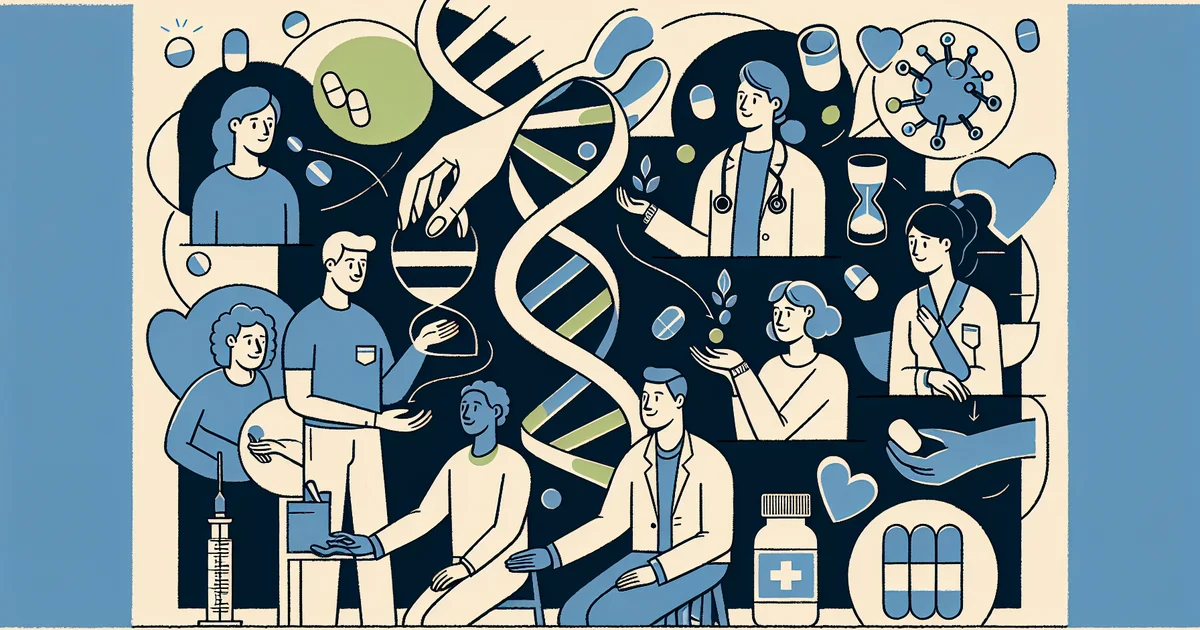
Finding the right antidepressant can feel like a guessing game. Many people try two or three different medicines before finding one that works well with manageable side effects. Pharmacogenomic testing – sometimes called PGx testing – uses your genes to predict how your body might process certain antidepressants. This could help your doctor choose a medicine that’s more likely to work for you from the start.
What is pharmacogenomic testing?
Pharmacogenomic testing looks at specific genes that affect how your body breaks down and responds to medicines. These genes produce enzymes (proteins that speed up chemical reactions) in your liver and other organs. Some people have gene variants that make these enzymes work faster or slower than average.
For antidepressants, two genes are especially important:
- CYP2D6 – affects how you process many common antidepressants, including some SSRIs (selective serotonin reuptake inhibitors) and tricyclic antidepressants
- CYP2C19 – affects how you process other antidepressants, including citalopram and escitalopram
If you’re a “poor metaboliser” (your enzymes work slowly), a standard dose might build up in your body and cause more side effects. If you’re an “ultra-rapid metaboliser” (your enzymes work very quickly), a standard dose might be broken down too fast to work properly.
The test itself is simple – usually a cheek swab or blood sample. A laboratory analyses your DNA and produces a report showing which category you fall into for each gene. Your doctor uses this information alongside other factors (your symptoms, medical history, other medicines you take) to choose an antidepressant and dose.
What does the evidence say?
The NHS currently recommends trying talking therapies (like cognitive behavioural therapy) first for depression, then considering antidepressants if therapy alone doesn’t help. When prescribing antidepressants, NICE guidelines suggest starting with an SSRI because they generally cause fewer side effects than older antidepressants.
In England, an NHS-supported pilot began testing pharmacogenomics in general practice in June 2023, looking at whether genetic information could guide prescribing of certain medicines – including some antidepressants, statins and stomach-acid medicines – before they are started. This kind of early work is mainly designed to find out whether testing is practical and acceptable to patients and GPs, rather than to prove it improves outcomes. NICE has not yet issued guidance recommending routine pharmacogenomic testing for everyone starting an antidepressant.
International guidelines from the Clinical Pharmacogenetics Implementation Consortium (CPIC) do give prescribing recommendations based on CYP2D6 and CYP2C19 results for several antidepressants. For SSRIs and similar medicines, CPIC suggests considering an alternative or a dose adjustment in people who are poor or ultra-rapid metabolisers – for example, using CYP2C19 results to guide citalopram and escitalopram. CPIC’s guidance is strongest for tricyclic antidepressants, where it recommends caution and dose changes in poor and ultra-rapid metabolisers. These are recommendations for when a test result is already available; they do not, on their own, mean everyone should be tested.
It’s important to understand what the test can’t do. Your genes are only one piece of the puzzle. They don’t predict whether an antidepressant will improve your mood – that depends on the biology of your depression, which isn’t yet fully understood. The test can’t tell you which antidepressant will definitely work best. It narrows down options by ruling out medicines more likely to cause problems or be ineffective based on how your body processes them.
When might pharmacogenomic testing help?
Pharmacogenomic testing might be particularly useful if:
- You’ve had serious side effects from antidepressants in the past, especially if you’ve tried several different types
- You’ve tried multiple antidepressants without finding one that works, and your doctor is considering what to try next
- You take other medicines that might interact with antidepressants, making the choice more complex
- You have a family history of unusual reactions to antidepressants or other medicines processed by the same enzymes
The test is less likely to be helpful if you’re just starting treatment for the first time. Standard practice (starting with an SSRI at a low dose and gradually increasing) works well for most people. The evidence for using gene tests routinely in everyone who needs an antidepressant is not yet strong enough for the NHS to recommend it as a first step.
How to access pharmacogenomic testing
Some NHS mental health trusts now offer pharmacogenomic testing through specialist clinics, particularly for people under the care of psychiatry services who have tried several antidepressants without success. Ask your GP or psychiatrist whether testing is available in your area.
Private pharmacogenomic tests are also available. If you choose this route, make sure:
- The laboratory is accredited (look for UK MHRA registration or equivalent)
- The report includes clear guidance for healthcare professionals, not just a list of genes
- You discuss the results with your GP or psychiatrist before making any changes to your medicines
Never stop or change antidepressants without talking to your doctor first, even if a gene test suggests a different medicine might suit you better. Stopping suddenly can cause withdrawal symptoms, and switching medicines needs to be done carefully to avoid a relapse of depression.
What you can do at Jeen
Jeen offers a pharmacogenomic test that analyses genes affecting how you process common medicines, including antidepressants. The test looks at CYP2D6, CYP2C19, and other genes relevant to mental health medicines. You’ll receive a report explaining your results in plain English, along with guidance on sharing the information with your GP or psychiatrist. While the test can’t replace a conversation with your doctor, it can provide useful information to guide treatment decisions, particularly if you’ve struggled to find an antidepressant that works for you.
Sources & further reading
- NHS England: Personalised medicine Accessed 16 June 2026.
- NICE: Depression in adults: treatment and management [NG222] Accessed 16 June 2026.
- CPIC Guideline for CYP2D6, CYP2C19, CYP2B6, SLC6A4 and HTR2A Genotypes and Serotonin Reuptake Inhibitor Antidepressants (Bousman et al., 2023, PMID 37032427) DOI:
10.1002/cpt.2903. Accessed 16 June 2026. - CPIC Guideline: Tricyclic Antidepressants and CYP2D6 / CYP2C19 Accessed 16 June 2026.
- NHS: Antidepressants Accessed 16 June 2026.
- MedlinePlus: What is pharmacogenomics? Accessed 16 June 2026.
- The Pharmaceutical Journal: Pharmacogenomic testing pilot to start in general practice from June 2023 Accessed 16 June 2026.