

How does Non-Invasive Prenatal Testing (NIPT) work, and what can it tell me about my baby's health?
NIPT screens for chromosomal conditions using cell-free fetal DNA from your blood. It's highly accurate for conditions like Down's syndrome, but it's a screening test, not a diagnosis.
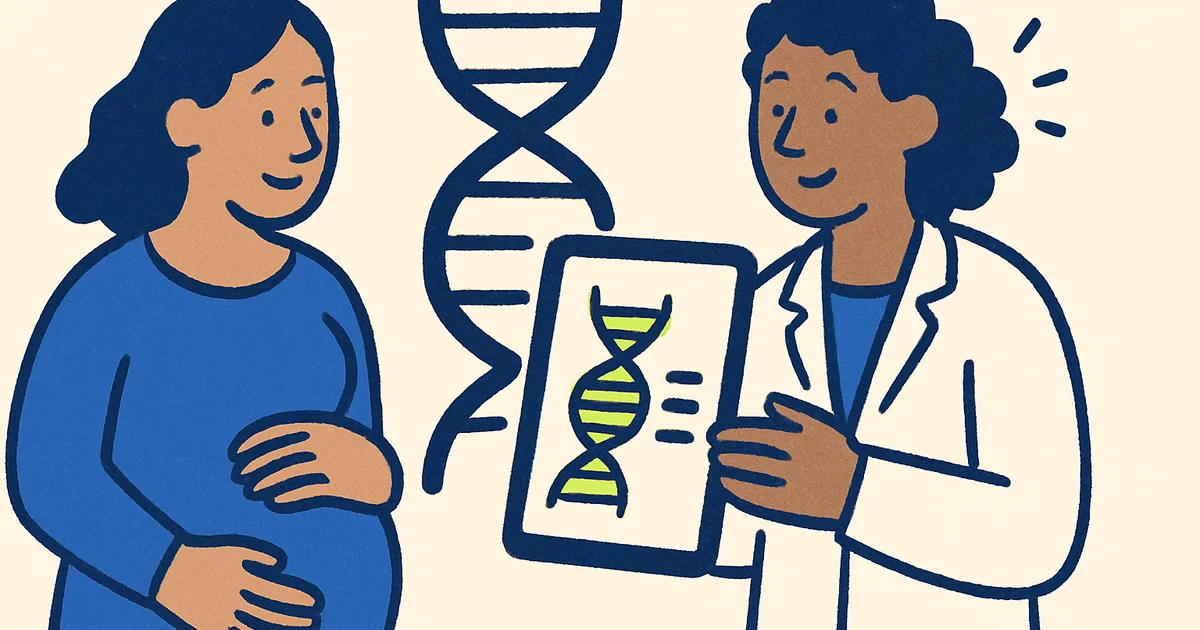
Non-invasive prenatal testing (NIPT) has changed how many people screen for chromosomal conditions during pregnancy. It uses a simple blood sample from your arm to check whether your baby might have conditions like Down’s syndrome (trisomy 21), Edwards’ syndrome (trisomy 18), or Patau’s syndrome (trisomy 13). Understanding how NIPT works and what it can and cannot tell you helps you make informed choices about your pregnancy care.
What is NIPT and how does it work?
NIPT analyses fragments of DNA that circulate freely in your blood during pregnancy. These fragments are called cell-free DNA. Some of this DNA comes from the placenta and reflects your baby’s genetic make-up. This fetal DNA can be detected from around 5 weeks of pregnancy onwards and increases as your pregnancy progresses.
The test itself is straightforward: a healthcare professional takes a blood sample from your arm, just like any other blood test. The sample goes to a laboratory where technicians use advanced sequencing technology to read the DNA fragments. They look at the amount of DNA from each chromosome to identify whether there might be extra or missing genetic material.
The laboratory uses a technique called next-generation sequencing (NGS) to analyse millions of DNA fragments at once. By counting fragments from different chromosomes, the test can identify patterns that suggest a chromosomal condition. For example, if there are more fragments from chromosome 21 than expected, this might indicate trisomy 21 (Down’s syndrome).
NIPT is available from 9 or 10 weeks of pregnancy, depending on which test you choose. Because it only requires a blood sample, it carries no risk of miscarriage, unlike invasive tests such as amniocentesis or chorionic villus sampling (CVS).
What conditions can NIPT screen for?
All NIPT tests screen for the three most common chromosomal conditions:
- Trisomy 21 (Down’s syndrome) - where there are three copies of chromosome 21 instead of two. Detection rates are very high for this condition.
- Trisomy 18 (Edwards’ syndrome) - an extra copy of chromosome 18, which causes severe developmental problems.
- Trisomy 13 (Patau’s syndrome) - an extra copy of chromosome 13, also causing severe health issues.
Some NIPT tests offer expanded panels that screen for additional conditions. These may include:
- Sex chromosome differences - such as Turner syndrome (missing an X chromosome) or Klinefelter syndrome (an extra X chromosome in boys).
- Microdeletions - small missing pieces of chromosomes that can cause conditions like DiGeorge syndrome or Prader-Willi syndrome.
- Other trisomies - less common chromosomal differences that may affect pregnancy outcomes.
Many tests also offer optional fetal sex determination, which has very high accuracy.
The number of conditions screened varies between tests. Basic panels cover the three main trisomies, while comprehensive panels may screen for dozens of conditions. More conditions on a panel does not necessarily mean a better test for your situation - it depends on your pregnancy, family history, and what information matters most to you.
How accurate is NIPT?
NIPT is described as a screening test, not a diagnostic test. This distinction is important: a screening test tells you the likelihood of a condition, while a diagnostic test gives a definite answer.
For the three main trisomies, NIPT performs very well. Detection rates exceed 99% for Down’s syndrome, meaning the test correctly identifies most pregnancies affected by this condition. Rates are also high for trisomies 18 and 13, though slightly lower than for trisomy 21.
However, NIPT can give false-positive results - indicating a high risk when the baby does not actually have the condition - or false-negative results, missing a condition that is present. False positives are more common than false negatives. This happens because the test analyses DNA from the placenta, which can sometimes have chromosomal differences that the baby does not share. Other factors, such as maternal health conditions, can also affect results.
For conditions beyond the three main trisomies, accuracy varies. Microdeletions and less common chromosomal differences are harder to detect reliably from cell-free DNA, and false-positive rates can be higher.
Because of these limitations, any high-risk NIPT result should be confirmed with a diagnostic test - either CVS or amniocentesis - before making decisions about your pregnancy. A diagnostic test analyses cells directly from the baby or placenta and provides a definitive answer.
What happens if my NIPT result is high risk?
A high-risk result means the test found patterns suggesting your baby might have a chromosomal condition. It does not mean your baby definitely has the condition.
If you receive a high-risk result, your healthcare team will discuss the next steps with you. These usually include:
- Counselling with a specialist - a genetic counsellor or fetal medicine consultant can explain what the result means for your specific situation and help you think through your options.
- Diagnostic testing - you will be offered amniocentesis or CVS to confirm whether the chromosomal difference is present. These tests analyse fetal cells directly and provide a definite diagnosis.
- Further scans - detailed ultrasound scans may look for physical features associated with the suspected condition.
You are not required to have a diagnostic test if you receive a high-risk NIPT result. Some people choose to continue their pregnancy without further testing. Others want confirmation before making decisions. Your healthcare team can support whichever choice feels right for you.
A low-risk result means the chance of the screened conditions is very small, though not zero. Most people with low-risk results go on to have healthy babies. However, NIPT does not screen for all possible health conditions. It focuses on chromosomal differences and does not detect structural problems, single-gene disorders (unless specifically designed to), or developmental issues that may appear later in pregnancy.
Occasionally, NIPT cannot provide a result. This happens in a small percentage of tests, often because there was not enough fetal DNA in the sample. If this occurs, you may be offered a repeat blood test or other screening options.
What should I consider before having NIPT?
NIPT gives you information, but deciding whether to have the test and what to do with the results is personal. Before arranging NIPT, think about:
- What you would do with the information - would a high-risk result change your decisions about your pregnancy? Would you want diagnostic testing to confirm the result? Some people want as much information as possible; others prefer not to know unless it affects their care.
- Which conditions you want to screen for - basic panels cover the most common and significant conditions. Expanded panels screen for rarer differences, some of which may have milder or uncertain effects. Consider whether more information would be helpful or anxiety-provoking.
- Your personal and family history - if you have a higher baseline risk for certain conditions (for example, because of your age or family history), NIPT may be particularly useful. If your risk is already low, you might still choose screening for reassurance.
- Timing - NIPT is available from 9 or 10 weeks, depending on the test. The NHS combined screening test has a blood test (10-14 weeks) and a nuchal translucency scan (11-14 weeks) that are usually done together, so NIPT can give you information sooner. Earlier information might help you plan, but it also means living with results for longer.
Discussing these questions with your midwife or a genetic counsellor before the test can help you decide whether NIPT is right for you.
What you can do at Jeen
Jeen offers several NIPT options to suit different needs and timelines. All our tests include a midwife consultation before you take the test (a £50 consultation fee applies if you speak with the midwife but testing does not go ahead), so you can discuss what the screening covers and whether it’s the right choice for you.
If you want a fast result, PrenatalSafe 3 UK screens for the three most common trisomies from 10 weeks of pregnancy, with a 2-4 working day turnaround once the sample reaches the laboratory. Your midwife reviews the results and arranges specialist follow-up if a high-risk result is found.
For a UK-based laboratory analysis, VeriSeq v2 NIPT uses Illumina’s VeriSeq v2 platform at TDL Genetics (The Doctors Laboratory) in the UK. It screens for the three main chromosomal conditions plus optional fetal sex from 10 weeks, with results in 3-4 working days.
If you are looking for a standard panel, Panorama NIPT is a standard test from 9 weeks of pregnancy, with a 7-10 working day turnaround and optional fetal sex reveal. To also screen for selected microdeletion syndromes, Panorama Microdeletions covers a wider range of microdeletions, with the same turnaround time.
For a mid-range multi-condition panel, Niptify NIPT is available from 10 weeks, with results in 5-10 working days and optional fetal sex reporting.
All these tests use a simple blood sample. You can arrange your own blood draw with no extra Jeen charge (check whether the clinic or surgery charges its own fee), or you can add a collection appointment at a partner clinic for an additional £40, or a home nurse visit for an additional £65. Turnaround times are counted from when the sample reaches the laboratory, not from when you order or have your blood drawn. Around 1-5% of genetic tests do not produce a result on the first attempt; if this happens, you are offered a free redraw.
The NHS offers combined screening (a blood test at 10-14 weeks and a nuchal scan at 11-14 weeks) free of charge to all pregnant women. This screens for Down’s syndrome, Edwards’ syndrome, and Patau’s syndrome. NIPT through Jeen can be done earlier (from 9 or 10 weeks, depending on the test), offers higher detection rates for the conditions it covers, and the option to screen for additional chromosomal differences not included in standard NHS screening. Your midwife can help you understand how NIPT compares to the NHS pathway for your situation.
Sources & further reading
- Non invasive prenatal testing (NIPT) for common aneuploidies and beyond DOI:
10.1016/j.ejogrb.2021.01.008. Accessed 2 October 2026. - Recent trends in prenatal genetic screening and testing DOI:
10.12688/f1000research.16837.1. Accessed 2 October 2026. - Implications of non-invasive prenatal testing for identifying and managing high-risk pregnancies DOI:
10.1016/j.ejogrb.2020.10.042. Accessed 2 October 2026.