

Should I have genetic testing if breast or ovarian cancer runs in my family but no one has been tested yet?
If breast or ovarian cancer runs in your family but no one has been tested, you may wonder whether genetic testing could help. This guide explains when testing is worth considering and what to expect as the first person in your family to be tested.
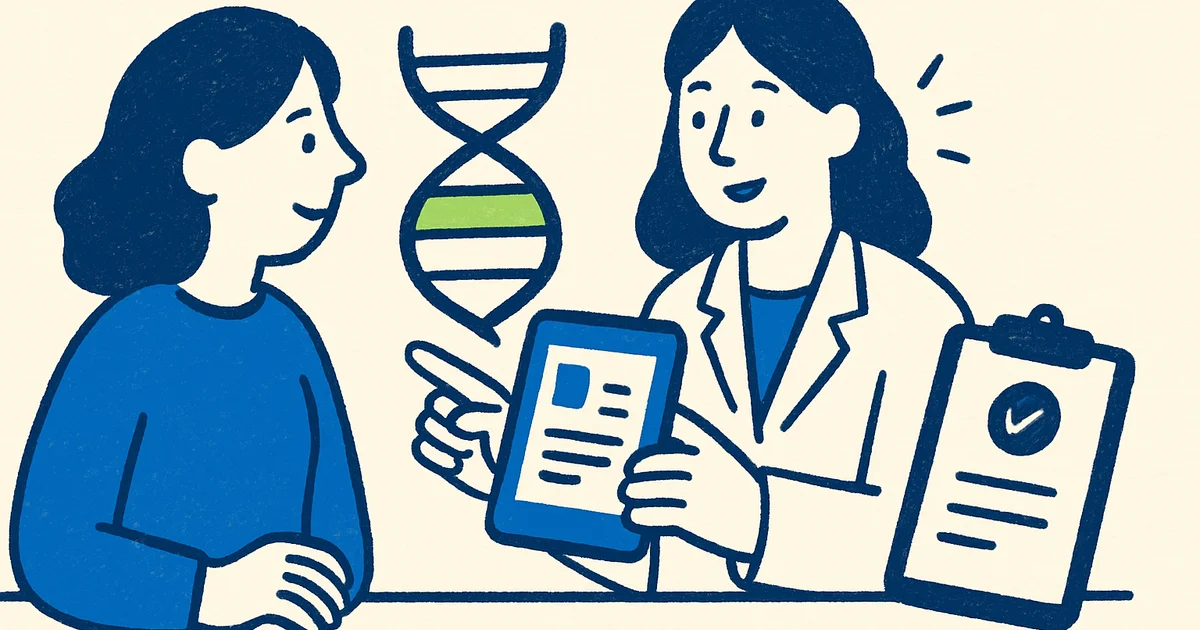
When breast or ovarian cancer affects several people in your family, it’s natural to wonder whether an inherited genetic change could be the cause. If no one in your family has had genetic testing yet, you may be unsure whether testing would help, or whether you should wait for a relative who has cancer to be tested first. Understanding what testing can - and cannot - tell you helps you decide whether it’s right for you now.
What does family history tell us about genetic risk?
Up to 10% of all cancers are linked to an inherited genetic change passed down through families. Breast and ovarian cancers can run in families for several reasons: shared genes, shared environments, or chance. A pattern of multiple cases at younger ages, or the same type of cancer in several close relatives, can suggest an inherited cause.
Pathogenic variants (gene changes that increase cancer risk) in genes such as BRCA1, BRCA2, PALB2, CHEK2 and ATM are among the most common causes of hereditary breast and ovarian cancer. BRCA1 and BRCA2 are the most widely known and carry the highest risks, but numerous additional genes demonstrate high and moderate penetrance for breast cancer. If one parent carries a pathogenic variant, each child has a 50% chance of inheriting it.
Knowing whether you carry a pathogenic variant can guide decisions about screening, risk-reducing treatments, and planning for the future. But the timing and approach to testing matter.
Who should be tested first in a family?
Ideally, the first person tested in a family is someone who has already had breast or ovarian cancer. If they test positive for a pathogenic variant, relatives can be tested for that specific change - a much more straightforward and informative process. If they test negative, it may mean no inherited cause is present, or that the gene involved is not yet known.
If everyone in your family with cancer has died, or cannot be tested for other reasons, you may still consider testing yourself. This is sometimes called ‘predictive’ or ‘first-in-family’ testing. It can find a pathogenic variant you carry, but a negative result is harder to interpret: it may mean you do not carry a known pathogenic variant, but it does not rule out an inherited risk altogether, because the family’s gene change might not yet be detectable with current tests.
When is testing worth considering if no one has been tested?
You may want to consider genetic testing if:
- Multiple close relatives (mother, sister, daughter, aunt, grandmother) have had breast or ovarian cancer, especially at younger ages (under 50).
- One or more relatives had cancer in both breasts, or both breast and ovarian cancer.
- There is male breast cancer in the family.
- Ashkenazi Jewish ancestry is present - certain BRCA variants are more common in this population.
- You have concerns about your own risk and want to explore screening or prevention options.
Genetic testing provides a tool to determine those patients with a genetic mutation and to whom appropriate preventive care and treatment may be offered. However, testing when no one in your family has had a confirmed pathogenic variant has limitations. A negative result does not guarantee you have no increased risk - only that no known pathogenic variant was found.
What does genetic testing involve?
Genetic testing for hereditary breast and ovarian cancer usually starts with a pre-test discussion with a genetic counsellor or healthcare professional. They review your family history, explain what the test can and cannot tell you, and help you decide whether testing is right for you.
The test itself uses a blood sample or cheek swab to look for pathogenic variants in a panel of genes. Modern multigene panels allow the identification of pathogenic variants in multiple predisposing genes with an impact on management, not just BRCA1 and BRCA2. Results typically take a few weeks.
A positive result means a pathogenic variant was found. You would be offered tailored screening (such as more frequent breast imaging or earlier mammograms) and may be eligible for risk-reducing treatments. Your relatives can then be tested for that specific variant.
A negative result is reassuring but, as noted, does not entirely rule out inherited risk, especially if you are the first person tested in a family with a strong cancer history.
A variant of uncertain significance (VUS) result means a gene change was found, but we do not yet know whether it increases cancer risk. Most VUS are later reclassified as benign. A VUS should not change your care, but your result may be updated as knowledge improves.
What you can do at Jeen
Jeen offers three focused genetic screening tests for hereditary breast and ovarian cancer, each with specialist genetic counselling included:
-
BRCA Testing: a 10-gene panel covering BRCA1, BRCA2 and the most actionable BRCA-pathway genes for hereditary breast, ovarian, prostate and related cancer predisposition. 45-minute specialist genetic counselling is included with every test. Results are provided within 17-21 working days of sample receipt. An at-home cheek swab is included; an in-clinic blood draw is available for an additional £40.
-
Breast Cancer Risk Screening: a 13-gene panel focused on hereditary breast cancer predisposition. Genetic counselling is included with every test. An at-home cheek swab is included; an in-clinic blood draw is available for an additional £40. Results are provided within 17-21 working days of sample receipt.
-
Ovarian Cancer Risk Screening: a 12-gene panel focused on hereditary ovarian cancer predisposition. Genetic counselling is included with every test. An at-home cheek swab is included; an in-clinic blood draw is available for an additional £40. Results are provided within 17-21 working days of sample receipt.
The NHS offers genetic testing for people who meet specific family-history criteria, but access can take time and may involve a referral process. Jeen’s panels can be booked directly without a GP referral, with counselling to help you understand your results and next steps. If you are the first person in your family to consider testing, a genetic counsellor can help you weigh the benefits and limitations of testing now versus waiting for a relative with cancer to be tested first.
Sources & further reading
- Hereditary Breast Cancer: BRCA Mutations and Beyond DOI:
10.1016/j.rcl.2023.12.014. Accessed 2 October 2026. - Cancer genetic counselling for hereditary breast cancer in the era of precision oncology DOI:
10.1016/j.ctrv.2024.102702. Accessed 2 October 2026. - Cancer Genetics DOI:
10.1016/j.suc.2020.02.012. Accessed 2 October 2026.