

Can genetic testing help explain why my child has developmental delays?
If your child has developmental delays, genetic testing can sometimes identify an underlying cause and guide next steps. Here's what parents need to know about how genetic tests work and when they might help.
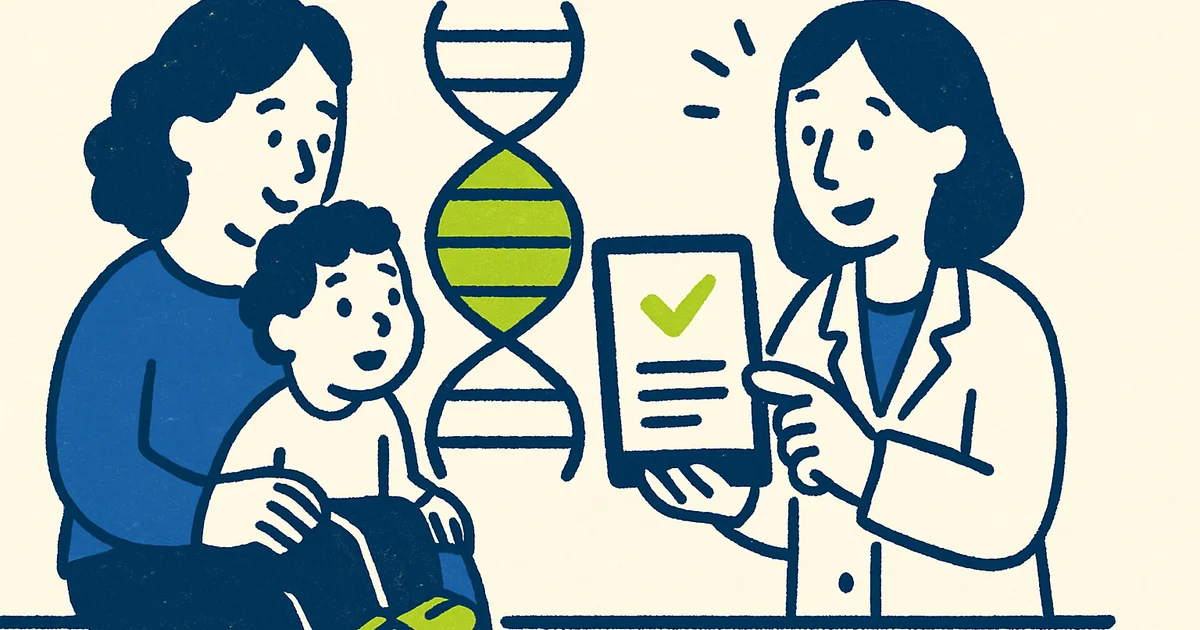
When a child isn’t meeting developmental milestones as expected - whether in movement, speech, social skills, or learning - parents and GPs often want to know why. Developmental delay (sometimes called global developmental delay) means a child is slower to reach key milestones compared to most children of the same age. While many delays have no single identifiable cause, genetic testing can sometimes pinpoint an underlying genetic condition and guide the next steps in care.
What is developmental delay?
Developmental delay describes when a child takes longer than usual to reach milestones such as sitting, walking, talking, or playing with others. A child might have delays in one area (for example, speech only) or across several areas - in which case it’s sometimes called global developmental delay.
Delays can be mild, moderate, or severe. Some children catch up over time, especially with the right support. Others have delays linked to a long-term condition that needs ongoing help. Causes include prematurity, complications at birth, environmental factors, and genetic conditions - but in many cases, no clear cause is found.
How genetic testing helps
Genetic tests look at a child’s DNA to see if there’s a change (called a variant or mutation) in a gene or chromosome that could explain the delay. Finding a genetic cause can:
- Provide a diagnosis. Knowing the specific genetic condition means families understand why the delays are happening and what to expect.
- Guide treatment and support. Some genetic conditions have targeted therapies or early interventions that improve outcomes.
- Inform family planning. If a condition is inherited, parents can receive genetic counselling about the chances of it affecting future children.
- Connect families to support. A diagnosis often opens doors to condition-specific charities, research studies, and parent networks.
Research shows that in children with developmental delays or features of autism spectrum disorder, identifying the underlying genetic subtype can help clinicians predict long-term cognitive and adaptive outcomes, though the developmental path varies even within a single genetic subtype.
Which genetic tests might be offered?
Several types of genetic test are used for children with developmental delays. Your GP or paediatrician will recommend the most appropriate test based on your child’s symptoms and medical history.
Chromosome analysis (karyotype)
This test looks at all 46 chromosomes under a microscope to spot large changes - such as an extra chromosome (like Down syndrome) or a missing or rearranged piece of chromosome. It’s one of the oldest genetic tests and remains useful for detecting numerical and large structural changes.
Chromosomal microarray
A microarray test looks for tiny deletions or duplications of genetic material that are too small to see on a standard karyotype. It can detect hundreds of microdeletion and microduplication syndromes - many of which cause developmental delays. This test is often one of the first genetic investigations offered.
Whole exome or genome sequencing
These advanced tests read either all the protein-coding regions of a child’s DNA (exome) or the entire genome. They can identify changes in individual genes that cause rare conditions. Whole exome sequencing is increasingly used when a microarray hasn’t found an answer and the clinical picture suggests a genetic cause.
Fragile X testing
Fragile X syndrome is one of the most common inherited causes of developmental delay and learning disability. A specific blood test looks for a repeat expansion in the FMR1 gene. This test is often done early in the diagnostic process, especially in boys with language delay and features of autism.
What happens during testing
Genetic testing for a child usually involves a blood sample, though some tests can be done using a saliva sample or cheek swab. The sample is sent to a specialist laboratory. Results can take several weeks to several months, depending on the complexity of the test.
Before testing, you’ll typically meet with a genetic counsellor or clinical geneticist who will:
- Take a detailed family history
- Explain which test is recommended and why
- Discuss what results might mean - including the possibility of not finding a clear answer
- Answer your questions about the process
Once results are back, the same team will explain what was found and what it means for your child’s care and your family.
Understanding the results
Genetic test results fall into three broad categories:
- A clear diagnosis. The test finds a known genetic change that explains the developmental delay. This result guides treatment, prognosis, and family planning.
- A variant of uncertain significance. A genetic change is found, but scientists aren’t yet sure whether it causes disease. These findings can be frustrating, though more information often emerges as research progresses.
- No clear cause found. The test doesn’t identify a genetic explanation. This doesn’t mean there isn’t a genetic factor - it may be that current tests can’t yet detect it, or that the delay has a non-genetic cause.
Even when testing doesn’t find a diagnosis, it can still be valuable. It rules out certain conditions, helps focus investigations elsewhere, and provides a baseline if new tests become available in the future.
When is genetic testing recommended?
Not every child with a developmental delay needs genetic testing. Your GP or paediatrician will consider testing if your child has:
- Global developmental delay affecting multiple areas
- Developmental delay plus other features such as unusual facial features, growth problems, seizures, or organ abnormalities
- A family history of genetic conditions or developmental delays
- Features of a known genetic syndrome
In many cases, your child will have other assessments first - such as hearing and vision tests, or brain imaging - to rule out other causes. Genetic testing is one piece of the puzzle, not always the first step.
What you can do at Jeen
If you’re expecting or have a young child, Jeen offers genetic testing options that can provide early insights or diagnostic clarity:
-
Panorama Microdeletions is a non-invasive prenatal screen available from 9 weeks of pregnancy. It screens for 13 conditions including several microdeletion syndromes that can cause developmental delays. The detection rate for trisomy 21 exceeds 99%, and results are available in 7-10 working days. A free midwife consultation is included before you take the test, so you can discuss whether screening is right for you.
-
Newborn Genetic Screening uses a simple oral swab to screen your newborn for a range of inherited conditions where early intervention improves outcomes - including treatable metabolic disorders, hearing impairment risk, and immune deficiencies. The NHS newborn blood-spot test screens for a small, fixed set of conditions; our panel covers many more, giving parents broader reassurance or earlier detection of conditions that benefit from prompt treatment.
-
Karyotype Chromosome Analysis examines all 46 chromosomes to detect numerical changes (such as trisomies) and large structural rearrangements. While it’s most often used by couples investigating recurrent miscarriage or fertility issues, it’s the same foundational test used in children to identify chromosomal causes of developmental delay.
Each test includes genetic counselling to help you understand the results and what they mean for your family. If your child is already showing developmental delays, your GP or paediatrician will coordinate NHS genetic testing as part of the diagnostic pathway - the tests above are designed for earlier screening or family-planning contexts rather than postnatal diagnosis.
Sources & further reading
- Arnett AB, Beighley JS, Kurtz-Nelson EC, et al. Developmental Predictors of Cognitive and Adaptive Outcomes in Genetic Subtypes of Autism Spectrum Disorder. Autism Research. 2020. DOI:
10.1002/aur.2385. Accessed 18 September 2026. - MedlinePlus: Developmental delay Accessed 18 September 2026.
- NHS: Genetic and genomic testing Accessed 18 September 2026.