

Should I have genetic testing for cystic fibrosis if it runs in my family?
If cystic fibrosis runs in your family, genetic testing can help you understand your risk of passing it on to your children. Carrier screening is most useful when planning a pregnancy.
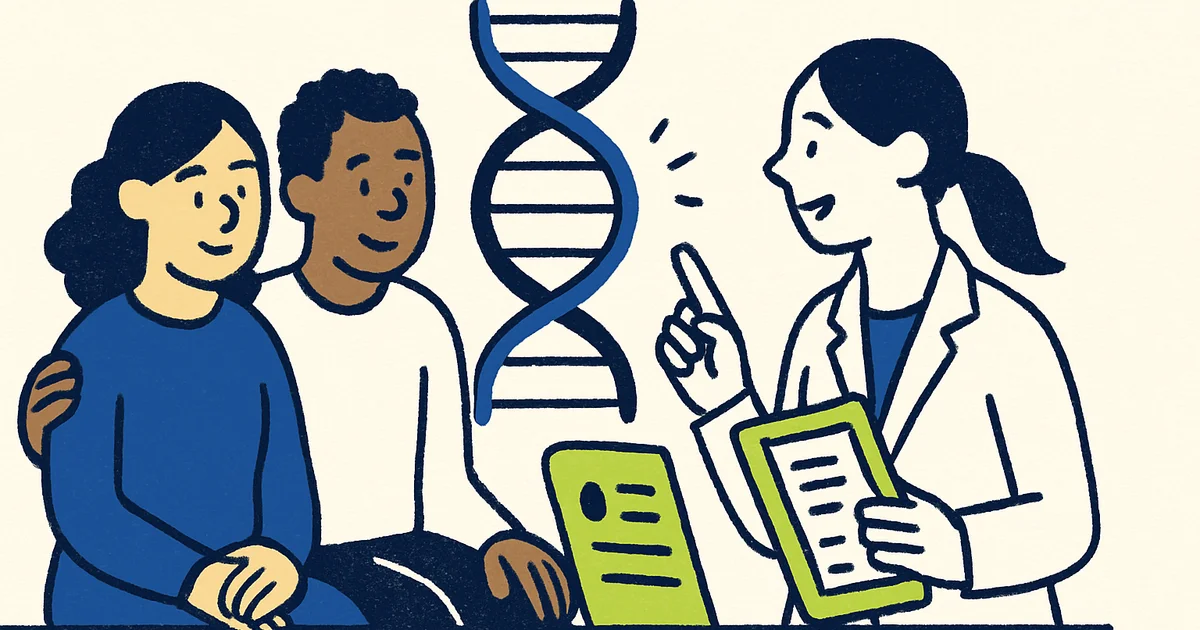
If cystic fibrosis has been diagnosed in your family, you may wonder whether you need genetic testing yourself. The answer depends on whether you have symptoms, and whether you are planning a family. This article explains when genetic testing makes sense, what it can tell you, and how it fits into family planning.
What is cystic fibrosis and how is it inherited?
Cystic fibrosis (CF) is a genetic condition that affects the lungs, digestive system, and other organs. It is caused by changes (called mutations) in a gene called CFTR. People with CF have two copies of a changed CFTR gene - one inherited from each parent.
If you have only one changed copy, you are a carrier. Carriers do not have cystic fibrosis and are usually healthy. However, if both parents are carriers, each of their children has a 1 in 4 chance of inheriting two changed copies and developing CF.
Cystic fibrosis is the most common life-limiting genetic condition in white populations. It can be diagnosed at any age, though newborn screening now identifies most cases in childhood.
Who should consider genetic testing?
Genetic testing for cystic fibrosis is most useful in three situations:
If you are planning a pregnancy and have a family history of CF. If a close relative (such as a sibling, child, niece, or nephew) has cystic fibrosis, you may be a carrier. Testing can show whether you carry a CFTR gene change. If your partner is also tested and neither of you is a carrier, your children will not have CF.
If your partner is a known carrier. If your partner has already been identified as a carrier (perhaps through their own family history), testing yourself helps you understand the risk to your future children. If both of you are carriers, you can discuss options such as IVF with genetic testing of embryos, or prenatal diagnosis during pregnancy.
If you have symptoms that might suggest CF. Adults can be diagnosed with cystic fibrosis later in life, particularly if they have milder forms. Symptoms such as repeated chest infections, bronchiectasis (damaged airways), chronic pancreatitis, or difficulty having children may prompt your doctor to arrange diagnostic testing. This is different from carrier screening - it looks for two changed CFTR genes that could explain your symptoms.
You do not need genetic testing just because CF exists somewhere in your extended family tree. The key question is: are you planning a pregnancy, and is there a realistic chance you are a carrier?
What does carrier screening involve?
Carrier screening for cystic fibrosis looks for changes in the CFTR gene. The test is usually done on a blood sample or a cheek swab (called a buccal swab). You do not need to be unwell or have symptoms.
There are hundreds of known CFTR mutations. Comprehensive carrier screening panels test for a large number of these changes, giving a more complete picture of your carrier status than older tests that looked for only the most common mutations. A 1,008-gene carrier panel (which includes CFTR alongside genes for other inherited conditions) can screen for many CFTR variants in a single test.
Results are usually ready within a few weeks of the laboratory receiving your sample. Genetic counselling - a discussion with a specialist trained in genetics - is an important part of carrier screening. The counsellor explains what the results mean, including any limitations of the test, and helps you think through the implications for family planning.
What will the test results tell you?
Carrier screening can give you one of three results:
-
You are not a carrier. The test did not find any CFTR gene changes. This means you are very unlikely to be a carrier, though no test can detect every possible mutation. Your children will not inherit CF from you (assuming your partner is also not a carrier).
-
You are a carrier. The test found one changed copy of the CFTR gene. You will not develop cystic fibrosis yourself, but you can pass the change on to your children. If your partner is also a carrier, each child has a 1 in 4 chance of having CF.
-
The result is uncertain. Occasionally, the test finds a CFTR change whose effects are not fully understood. This is called a variant of uncertain significance. Your counsellor will discuss what this means and whether further testing might help.
If both you and your partner are carriers, genetic counselling becomes especially important. You can discuss reproductive options, including natural conception with the understanding of the risk, IVF with pre-implantation genetic testing, or prenatal diagnosis during pregnancy.
Are there any health risks to being a carrier?
For many years, it was thought that carriers - people with one changed CFTR gene - were entirely unaffected. Recent research suggests that carriers may have a slightly increased risk of certain conditions, such as chronic pancreatitis, bronchiectasis, or infections with atypical bacteria. However, most carriers remain healthy throughout their lives.
If you are a carrier and develop symptoms such as repeated chest infections or unexplained digestive problems, mention your carrier status to your GP. They may refer you for further assessment if needed.
How accurate is carrier screening?
Carrier screening for cystic fibrosis is highly accurate at detecting the CFTR mutations it is designed to look for. However, no test can find every possible CFTR change - there are many rare mutations, and new ones continue to be discovered.
A negative test (showing you are not a carrier) reduces your risk substantially, but does not eliminate it entirely. If you have a strong family history of CF, or if you and your partner are from populations with less-studied CFTR mutations, genetic counselling can help you understand your residual risk.
What you can do at Jeen
If you are planning a pregnancy and want to understand your carrier status for cystic fibrosis (and many other inherited conditions), Jeen offers comprehensive pre-conception carrier screening.
Our Carrier Screening tests for CFTR changes alongside 1,007 other genes associated with inherited recessive conditions. The test uses an at-home buccal swab (a cheek swab you collect yourself), or you can arrange an in-clinic blood draw for an additional £40. Results are available within 17-21 working days of the laboratory receiving your sample. Every test includes a 30-minute genetic counselling session with a specialist trained in reproductive genetics, and our variant interpretation follows NHS Genomic Medicine Service standards.
For a more complete pre-conception work-up, our Carrier Screening + Karyotype bundles the 1,008-gene carrier panel with chromosome-level karyotype analysis. This combination checks for both single-gene conditions (like CF) and chromosomal abnormalities that could affect pregnancy outcomes. It requires one blood draw and produces one integrated report, with 30-minute genetic counselling covering both tests. Couples save £130 by ordering this bundle rather than the tests separately.
Both options give you a comprehensive view of reproductive genetic risks before you conceive, so you can make informed decisions with the support of specialist genetic counselling.
Sources & further reading
- O'Sullivan BP, Freedman SD. Cystic fibrosis. Lancet. 2009 DOI:
10.1016/S0140-6736(09)60327-5. Accessed 28 July 2026. - Polgreen PM, Comellas AP. Clinical Phenotypes of Cystic Fibrosis Carriers. Annu Rev Med. 2022 DOI:
10.1146/annurev-med-042120-020148. Accessed 28 July 2026. - Dequeker E, et al. Best practice guidelines for molecular genetic diagnosis of cystic fibrosis and CFTR-related disorders. Eur J Hum Genet. 2009 DOI:
10.1038/ejhg.2008.136. Accessed 28 July 2026. - Bobadilla JL, et al. Cystic fibrosis: a worldwide analysis of CFTR mutations. Hum Mutat. 2002 DOI:
10.1002/humu.10041. Accessed 28 July 2026.