

How does genetic testing help manage my risk of colorectal cancer if a close family member had it?
If a close relative has had colorectal cancer, genetic testing can identify inherited gene changes that increase your risk and guide personalised screening plans to catch cancer early or prevent it.
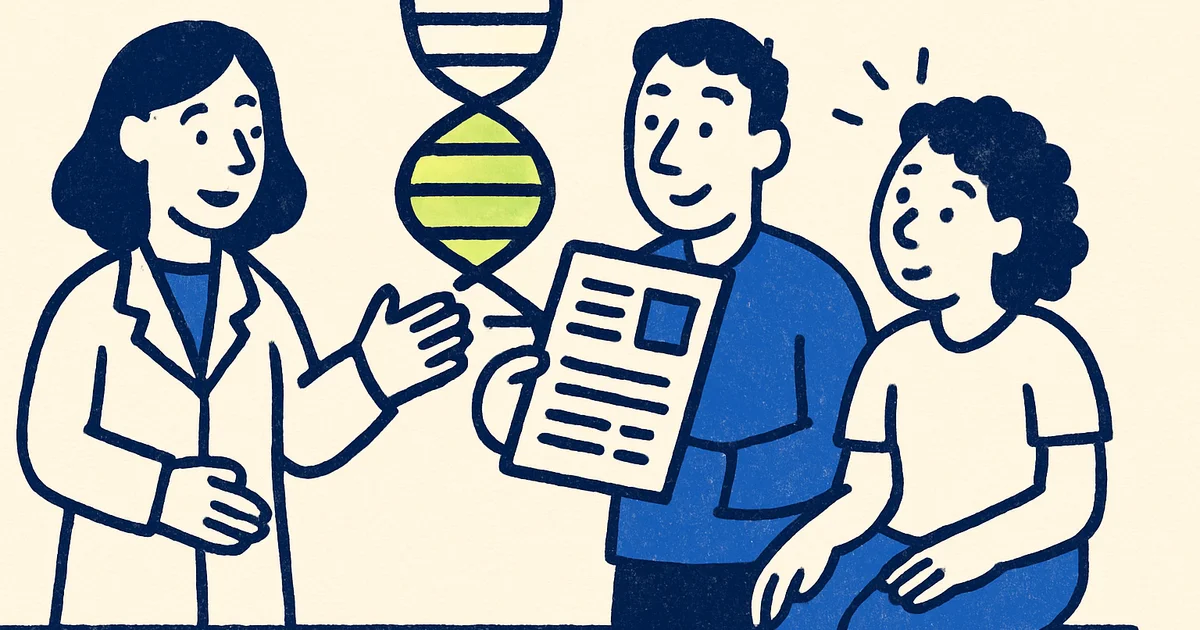
Having a close family member with colorectal cancer (also called bowel cancer) can be worrying. You might wonder whether you’re at higher risk and what you can do about it. Genetic testing can help answer these questions by looking for inherited gene changes that increase cancer risk and guiding more effective screening strategies.
Why family history matters for colorectal cancer risk
Most colorectal cancers develop in people with no family history. However, your risk increases if a close relative – a parent, sibling or child – has had the disease. The younger they were when diagnosed, and the more relatives affected, the higher your risk.
In some families, colorectal cancer runs through generations because of an inherited gene change (also called a pathogenic variant or mutation). These gene changes can be passed from parent to child. If you inherit one, your risk of developing colorectal cancer is significantly higher than the general population.
The most common hereditary cause is Lynch syndrome, caused by changes in genes that normally repair DNA. People with Lynch syndrome have a high lifetime risk of colorectal cancer and may also face increased risks of womb, ovarian and other cancers. Another condition, familial adenomatous polyposis (FAP), is rarer but causes hundreds of polyps (small growths) in the bowel that can become cancerous if not removed.
Not every family history of colorectal cancer means there’s an inherited gene change. Sometimes, several family members develop cancer by chance, or because they share environmental factors like diet or smoking. Genetic testing helps distinguish hereditary cancer from other patterns.
What genetic testing looks for
Genetic testing for colorectal cancer analyses your DNA to look for changes in specific genes known to increase cancer risk. The test is usually done on a blood sample or cheek swab.
Key genes tested include:
- MLH1, MSH2, MSH6 and PMS2: Changes in these genes cause Lynch syndrome, the most common hereditary colorectal cancer syndrome.
- APC: Changes in this gene cause familial adenomatous polyposis (FAP), where hundreds of polyps develop in the bowel.
- MUTYH: Changes in both copies of this gene (one from each parent) cause MUTYH-associated polyposis (MAP), another condition that increases polyp and cancer risk.
- STK11 and SMAD4: Changes in these genes cause rarer syndromes that can include bowel polyps and cancer.
A typical colorectal cancer genetic test examines multiple genes at once. Broader cancer panels may include additional genes linked to other cancers, which can be useful if your family history includes different cancer types.
How testing helps manage your risk
If genetic testing finds a gene change that increases your colorectal cancer risk, the result directly informs your medical care.
Personalised screening
People with an inherited gene change usually need more frequent and earlier screening than the general population. For example:
- Lynch syndrome: Colonoscopy (a camera examination of the bowel) is typically recommended every 1-2 years, starting in your 20s or 30s rather than at age 50.
- FAP: Very frequent colonoscopies may start in the teenage years because polyps develop early and progress rapidly.
These personalised screening schedules aim to catch polyps or early cancers when they’re easiest to treat or prevent entirely.
Preventive options
In some cases, knowing you carry a high-risk gene change opens the door to preventive measures:
- Aspirin: Some evidence suggests daily aspirin may reduce colorectal cancer risk in people with Lynch syndrome, though you should discuss benefits and risks with your doctor.
- Surgery: For conditions like FAP, where cancer risk is very high, removing part or all of the colon (a colectomy) may be recommended to prevent cancer developing.
Informing family members
If you test positive for a gene change, your close relatives – siblings, children, parents – have up to a 50% chance of carrying the same change. They can then have predictive genetic testing to find out their own status. Relatives who test negative do not have the increased cancer risk and can follow standard screening guidelines.
This is called cascade testing and is one of the most valuable aspects of genetic testing: it allows at-risk family members to take action early, potentially saving lives.
Guidance if the test is negative
If genetic testing does not find a gene change, it doesn’t mean you have no increased risk. Your family history still matters, and your doctor will recommend a screening plan based on factors like how many relatives had cancer and at what age. The test may have missed a rarer gene change, or the cancer in your family may not be due to a single inherited gene.
What happens during genetic testing
Genetic testing for hereditary colorectal cancer typically involves:
- A consultation with a genetic counsellor or specialist: They’ll review your family history, explain what the test can and cannot tell you, and discuss the possible results.
- Sample collection: Usually a blood sample or cheek swab. At-home kits may be available for some tests.
- Laboratory analysis: Your DNA is examined for changes in the relevant genes. Results take several weeks.
- Results discussion: A follow-up appointment explains what the test found and what it means for your screening, treatment and family.
You can choose not to proceed with testing after counselling, and you can decide whether to share results with family members. There’s no obligation.
What you can do at Jeen
At Jeen, we offer focused genetic testing for hereditary colorectal cancer risk. Our Colorectal Cancer Risk Screening analyses a 14-gene panel covering the key genes linked to inherited colorectal cancer, including those that cause Lynch syndrome, FAP and MAP. Genetic counselling is included with every test, and variant interpretation aligns with NHS Genomic Medicine Service standards. An at-home buccal swab is included; an in-clinic blood draw is available for an additional £40. Results are returned within 17-21 working days of the sample reaching the laboratory.
If your family history includes other cancers beyond colorectal, our broader Cancer Risk Screening covers 50 genes linked to hereditary cancer predisposition, including breast, ovarian, prostate and pancreatic cancers. This test includes 45-minute specialist genetic counselling and uses the same at-home swab or in-clinic blood-draw options, with results in 17-21 working days.
For those planning a family and also concerned about cancer risk, the Combined Cancer + Carrier Screening bundles our 50-gene hereditary cancer panel with a 1,008-gene carrier-screening panel in one test, one counselling session and one report.
The NHS offers some genetic testing through clinical genetics services, typically covering a smaller set of well-established genes. Our panels provide broader coverage and may identify changes in genes not routinely tested by the NHS, giving you a more comprehensive assessment of your hereditary cancer risk. If you’re considering genetic testing, speak to your GP about whether an NHS referral is appropriate, or explore private testing options that suit your needs.
Sources & further reading
- NHS - Bowel cancer screening Accessed 28 August 2026.
- NICE - Colorectal cancer (update) guideline Accessed 28 August 2026.
- NHS - Lynch syndrome Accessed 28 August 2026.