

What are aneuploidies and should I consider NIPT to screen for them during pregnancy?
Aneuploidies are chromosome conditions where a baby has too many or too few chromosomes. NIPT is a highly accurate, non-invasive blood test that screens for the most common aneuploidies from 9–10 weeks of pregnancy.
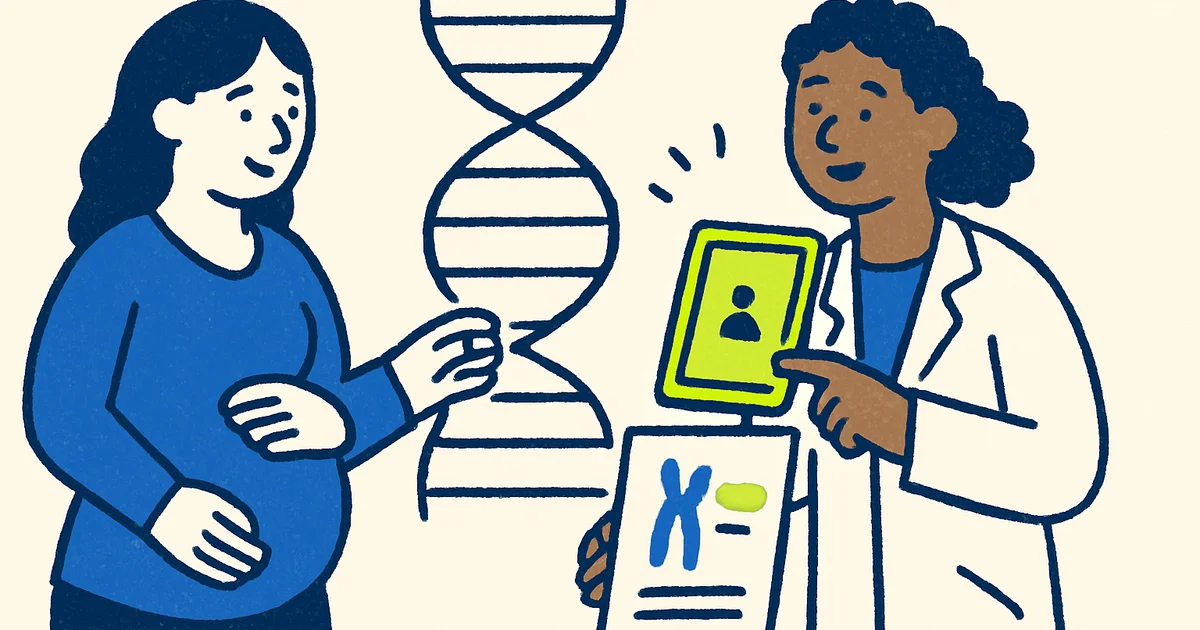
Aneuploidies are chromosome conditions where a baby has too many or too few chromosomes. The most common is Down’s syndrome (also called trisomy 21), where the baby has three copies of chromosome 21 instead of the usual two. These conditions can affect a baby’s development and health, and many parents want to know whether their pregnancy is affected.
Non-invasive prenatal testing (NIPT) is a blood test that screens for the most common aneuploidies from as early as 9 weeks of pregnancy. It analyses small fragments of DNA from the placenta that circulate in your blood. NIPT has the highest detection rate and lowest false-positive rate among aneuploidy screening methods, but it’s not perfect – false-positive results can occur. This article explains what aneuploidies are, how NIPT works, and whether screening is right for you.
What are aneuploidies?
Most people have 46 chromosomes arranged in 23 pairs – 22 numbered pairs plus a pair of sex chromosomes (XX or XY). Aneuploidies happen when a baby has an extra or missing chromosome. The three most common aneuploidies screened for in pregnancy are:
- Down’s syndrome (trisomy 21): three copies of chromosome 21 instead of two. This affects learning and can cause heart defects and other health conditions. It’s the most common aneuploidy.
- Edwards’ syndrome (trisomy 18): three copies of chromosome 18. This causes serious health problems, and most babies with Edwards’ syndrome die before or shortly after birth.
- Patau syndrome (trisomy 13): three copies of chromosome 13. This also causes life-limiting health problems, and most affected babies die in their first weeks or months.
Other aneuploidies involve the sex chromosomes (such as Turner syndrome or Klinefelter syndrome) or rarer numbered chromosomes. Some NIPT panels screen for these as well.
Aneuploidies usually happen by chance when the egg or sperm forms – they’re not typically inherited. The chance of an aneuploidy increases with maternal age, but they can occur in any pregnancy.
How does NIPT work?
During pregnancy, small fragments of DNA from the placenta enter your bloodstream. NIPT analyses this cell-free DNA (called cffDNA) in a sample of your blood to estimate the chance that the pregnancy is affected by an aneuploidy.
The test measures the amount of DNA from each chromosome. If there’s an extra copy of chromosome 21 in the baby, for example, the lab will detect slightly more chromosome 21 DNA in your blood sample than expected.
NIPT is available from 9 or 10 weeks of pregnancy, depending on the specific test. It requires only a blood sample from your arm – no needles near the baby – so it carries no risk of miscarriage. Results are usually ready within a few days to 10 working days, depending on the laboratory and panel.
What NIPT can and cannot tell you
NIPT is a screening test, not a diagnostic test. A high-risk result means the chance of the condition is increased, but it doesn’t confirm the baby definitely has it. Similarly, a low-risk result means the chance is very low, but not zero. If NIPT returns a high-risk result, you’ll be offered genetic counselling and the option of a diagnostic test – either chorionic villus sampling (CVS) or amniocentesis – to confirm the result.
NIPT performs very well for detecting the common autosomal aneuploidies (trisomy 21, 18, and 13). For Down’s syndrome, NIPT has a detection rate above 99% and a very low false-positive rate. However, false-positive results can occur – for example, due to confined placental mosaicism (where the placenta has an aneuploidy but the baby does not) or other biological factors.
NIPT does not screen for all pregnancy complications or birth defects. A 12- or 13-week ultrasound scan is still recommended alongside NIPT, as it can identify structural abnormalities – such as heart defects or neural tube defects – that NIPT cannot detect.
Should you have NIPT?
In the UK, the NHS offers combined first-trimester screening (a blood test and nuchal translucency ultrasound at 11–14 weeks) to all pregnant people. NIPT is not routinely available on the NHS in England, though some NHS trusts offer it in specific circumstances (such as after a high-risk combined test result). In Scotland, Wales, and Northern Ireland, policies vary.
Private NIPT is widely available and does not require a GP referral. Whether to have NIPT is a personal decision. Consider:
- Do you want to know? Some people want as much information as possible during pregnancy. Others prefer not to screen, or would not change their pregnancy plans based on the result.
- What would you do with the result? Knowing whether the baby has an aneuploidy can help you prepare emotionally, plan for specialist care after birth, or make decisions about continuing the pregnancy. If the result wouldn’t affect your plans or preparations, screening may not be helpful for you.
- Timing: NIPT is available earlier than the NHS combined test (from 9–10 weeks rather than 11–14 weeks), which can provide reassurance sooner or allow more time for decision-making if a high-risk result is found.
- Accuracy: NIPT has a higher detection rate and lower false-positive rate than combined screening, meaning fewer people receive a high-risk result that turns out to be incorrect. However, no screening test is perfect.
There is no right or wrong choice. A midwife or genetic counsellor can discuss your options without pressure, helping you decide what fits your values and circumstances.
What happens if NIPT shows a high-risk result?
A high-risk NIPT result does not mean your baby definitely has the condition. You’ll be offered:
- Genetic counselling: a specialist will explain what the result means, the condition itself, and your options.
- Diagnostic testing: CVS (from around 11 weeks) or amniocentesis (from around 15 weeks) can confirm whether the baby has the aneuploidy. These tests carry a small risk of miscarriage (less than 1 in 100 for amniocentesis).
If the diagnostic test confirms an aneuploidy, you’ll have time to discuss what this means for your baby and family, plan for specialist care, or consider all your options, including continuing or ending the pregnancy. Support is available whatever you decide.
What you can do at Jeen
Jeen offers several NIPT options to suit different needs and timelines, all with a free midwife consultation before you take the test:
- Panorama NIPT: an industry-standard 9-condition panel available from 9 weeks of pregnancy, with results in 7–10 working days. Optional fetal sex reveal with over 99% accuracy.
- Niptify NIPT: a mid-range 33-condition panel available from 10 weeks, with results in 5–10 working days and optional fetal sex reveal.
- PrenatalSafe 3 UK: the fastest turnaround option (2–4 working days), screening for the 3 most common aneuploidies from 10 weeks. Detection rate over 99% for trisomy 21. Results are reviewed by your midwife, with specialist follow-up if high-risk.
- VeriSeq v2 NIPT: analysed on Illumina’s VeriSeq v2 platform at TDL Genetics (The Doctors Laboratory) in the UK. Screens for the 3 most common chromosomal conditions from 10 weeks, with optional fetal sex reporting and a 3–4 working day turnaround. Results are reviewed by your midwife, with specialist follow-up if high-risk.
- Aneuploidy NIPT: a standard non-invasive prenatal screen available from 9 weeks, with a detection rate over 99% for trisomy 21. Results returned with clinical interpretation.
The NHS newborn blood-spot screen (heel-prick test) checks for a small, fixed set of serious conditions after birth. NIPT, by contrast, screens during pregnancy for chromosomal conditions, giving you information earlier and more time to prepare or make decisions. All Jeen NIPT tests use an at-home buccal swab or blood sample (blood collection is not included in the test price; you arrange your own blood draw, or pay extra for a partner collection point or home-nurse visit). Each test includes a free midwife consultation to help you understand your options and results.
Sources & further reading
- Poulton A, Hui L. Noninvasive prenatal testing: an overview. Aust Prescr. 2025;48(2):47-53. DOI:
10.18773/austprescr.2025.019. Accessed 22 September 2026. - Gadsbøll K, Vogel I, et al. Combined first-trimester screening and invasive diagnostics for atypical chromosomal aberrations: Danish nationwide study. Ultrasound Obstet Gynecol. 2024;64(4):470-479. DOI:
10.1002/uog.27667. Accessed 22 September 2026. - Konya M, Czimbalmos A, et al. Genome-Wide, Non-Invasive Prenatal Testing for rare chromosomal abnormalities: A systematic review and meta-analysis. PLoS One. 2024;19(11):e0308008. DOI:
10.1371/journal.pone.0308008. Accessed 22 September 2026.